Veneer or Solid Wood? A 5-Year Dining Table Cost Comparison
A dining table is one of the few pieces of furniture that combines daily use, visible material grain, and long-term ownership. For Singapore households in HDB flats and condos across Tampines, Bedok, and Punggol, the choice between veneer and solid wood can affect the purchase price, delivery logistics, maintenance schedule, and resale value over 5 years.
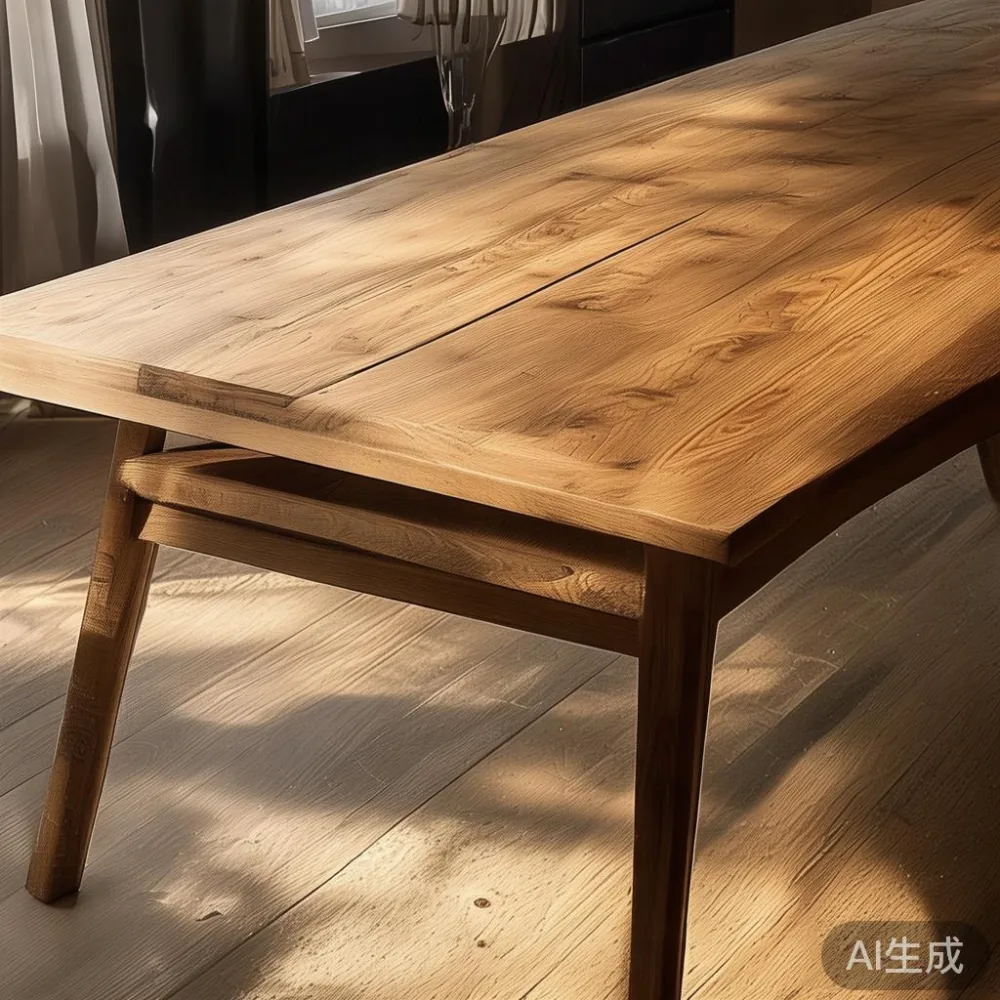
This comparison uses a 180 cm solid wood dining table priced at SGD 2,280 against a 180 cm veneer dining table priced at SGD 1,280. Both examples are illustrative, with figures including a standard local delivery charge but excluding GST. MIDHILL is a Foshan solid wood furniture maker established in 2008, exporting to more than 15 countries, offering a 10-year structural warranty, lifetime refinishing, free shipping over US$350, and 14-day returns.
The figures also allow for Singapore conditions: a 70 cm wide HDB corridor, a lift door measuring approximately 90 cm by 210 cm, tropical humidity, frequent cleaning, and the need to move a dining table between a flat and a nearby service area. A lighter veneer table may be easier to handle upstairs, but the empty lift space—not just the table's weight—can still determine whether delivery is straightforward.
What is the real 5-year cost of a veneer dining table?
A veneer dining table uses a thin layer of natural timber, usually about 0.6 mm to 1.2 mm, bonded to a particleboard or MDF core. The examples below assume a 180 cm by 90 cm table with four legs, a rectangular top, and a wood-grain finish. Veneer can look convincing because the printed or sliced surface follows the grain, and it can provide consistent colour across mass-produced pieces.
The purchase price is SGD 1,280 before GST. A Singapore GST rate of 9% adds SGD 115.20, bringing the initial cost to SGD 1,395.20. For a local HDB delivery within Tampines, assume SGD 80; a condo delivery in Bedok may include parking or lift coordination and cost SGD 120. The customer still needs a trolley, moving blankets, and at least one helper.
Across 5 years, the illustrative maintenance budget is SGD 450. That includes SGD 120 for edge inspection, SGD 180 for minor veneer repair or touch-up, SGD 90 for hinge-free leg adjustment or tightening, and SGD 60 for cleaning supplies. No structural replacement is expected if the table is kept away from persistent standing water.
The total 5-year cash outlay is therefore SGD 1,925.20 when adding GST, delivery, and maintenance: SGD 1,395.20 + SGD 80 + SGD 450. The average annual cost is SGD 385.04. If the table is replaced after 5 years, its remaining resale value may be close to SGD 200 because veneer furniture loses value faster when edges, corners, or the surface pattern become marked.
Veneer is not automatically a poor choice. It can suit a compact dining area, an apartment with controlled indoor humidity, or a household that wants the appearance of timber without the full purchase price of solid wood. The important question is whether the lower price compensates for a shorter service life and a narrower repair scope.
How much does a solid wood dining table cost over 5 years?
The comparison solid wood dining table uses a 180 cm by 90 cm top made from kiln-dried hardwood, with a net weight of approximately 58 kg. The purchase price is SGD 2,280 before GST. Adding 9% GST produces SGD 2,485.20. A local delivery in Tampines is estimated at SGD 100, while a Bedok condo delivery with lift reservation is estimated at SGD 150.
For a real installation, the delivery team should check the lift opening, turning radius, corridor width, and the route to the dining area. A 58 kg table is heavy for one person to carry through a 90 cm lift door, so two or three people and a padded moving dolly are sensible. The table should be moved in its protective packaging, with the top separated from the base only if the manufacturer confirms that this will not damage the joints.
The 5-year maintenance allowance is SGD 260: SGD 80 for an oil or wax refresh, SGD 100 for hinge-free leg tightening and alignment, and SGD 80 for small sanding and refinishing work. A solid surface can accept localised repairs that would not blend invisibly into a printed veneer face. If a scratch cuts through the finish, the bare timber can often be spot-treated without replacing the whole top.
Adding GST, delivery, and maintenance gives SGD 2,845.20 for the first 5 years when using the Tampines delivery figure: SGD 2,485.20 + SGD 100 + SGD 260. That is SGD 920 more than the veneer example, or about 47.8% higher. The average annual cost is SGD 569.04.
The higher initial cost buys more material in the wear-prone areas, a repairable surface, and a product that can remain in service for 10 years or more with care. MIDHILL's 10-year structural warranty and lifetime refinishing policy are relevant here, because structural confidence and refinishing support reduce the likelihood that owners will replace a sound dining table after only 5 years.
What are the hidden costs Singapore buyers often miss?
Delivery is the first hidden cost. A solid wood dining table may need a larger vehicle, more lift booking time, or additional labour in an older HDB block. A Punggol condo with a narrow service corridor can add SGD 50 to SGD 120 if the route requires a second carrying team or extended protection of walls and flooring. A veneer dining table weighing 31 kg can still require two people, but it is usually less demanding on stairs and lift thresholds.
Space is another cost. A 180 cm table needs approximately 90 cm on each side for chairs and circulation, giving a comfortable footprint of 360 cm by 170 cm. A compact 140 cm dining table may fit a smaller flat more easily, but the surface area per diner is lower. The comparison uses 180 cm because it works for four to six people in many Singapore dining zones, provided the room can accommodate the clearances.
Humidity management is less visible but more consistent. Singapore's outdoor air can approach 80% relative humidity during wet periods, while air-conditioned interiors may sit near 55%. Solid wood can move by several millimetres as timber responds to seasonal moisture changes. A quality table should use joinery that accommodates this movement, and the owner should avoid placing it directly beside an open window or an air-conditioning vent.
For veneer, humidity can cause edge swelling, bubbling, or delamination if the core and face are exposed to water. Sealing the underside and edges, using coasters, and wiping spills promptly reduce this risk. Neither material should be cleaned with a soaked cloth or abrasive pads.
Finally, consider the cost of mistakes. A dropped hot pan can scorch a veneer finish, while an oiling treatment on solid wood may be recoverable. Replacing one damaged veneer panel may require matching a grain pattern and waiting for production, whereas a solid top can be refinished locally. The value of repairability is difficult to calculate in advance, but it belongs in a 5-year ownership budget.
Is a solid wood dining table worth the extra SGD 920?
For a household expecting to keep the same dining table for at least 5 years, the numbers favour solid wood when the table is used daily and moved rarely. The extra SGD 920 over 5 years is equivalent to SGD 184 per year. If the veneer table needs a new surface, veneer edge repair, or replacement in year 4, the apparent saving may disappear quickly.
The calculation changes for a rental flat, a short-term home, or a room where the table is treated as a temporary surface. A buyer who expects to move within 24 months may prefer the SGD 1,280 veneer model and accept a lower repair expectation. The useful comparison is not simply purchase price; it is cost per year of useful ownership.
The following chart-style breakdown makes the difference clear:
Veneer dining table: SGD 1,280 before GST, plus SGD 115.20 GST, SGD 80 delivery, and SGD 450 maintenance, giving SGD 1,925.20 over 5 years.
Solid wood dining table: SGD 2,280 before GST, plus SGD 205.20 GST, SGD 100 delivery, and SGD 260 maintenance, giving SGD 2,845.20 over 5 years.
Solid wood costs more at purchase, but the comparison assumes lower repair and refinishing expenditure. The result is not universal: a very cheap veneer table with poor core quality may require more maintenance than expected, while a well-made solid table with careful care may last far beyond the 5-year window. Ask for the timber species, core material, finish type, joint construction, and warranty terms before deciding.
French light luxury often uses pale oak, walnut accents, slim profiles, and restrained hardware. A solid wood dining table suits that design language because the grain remains part of the object rather than a printed imitation. American light luxury tends to pair warmer timber with generous proportions, while post-modern light luxury may combine a clean rectangular top with sculptural legs. In each case, material authenticity affects the impression of the room.
How do I choose the right dining table for my flat or condo?
Measure before ordering. Confirm the longest usable wall, the dining-room door width, the lift interior, and the narrowest corridor turn. For a Tampines HDB flat, a 180 cm table may work in a dining area with at least 330 cm of clear length after allowing for chair pull-out. In a Bedok condo, check whether the lift has a protective wall pad and whether the service corridor narrows below 90 cm.
Choose a table height of 74 cm to 76 cm for standard dining chairs. A solid top that weighs 58 kg will be difficult to reposition; extendable models with removable sections can offer flexibility, although their joints need regular inspection. For veneer, confirm that the face veneer is continuous across the top and ask whether the edges are sealed. A 0.6 mm veneer may be acceptable for a low-use table, while 1.2 mm veneer generally has more repair resilience.
Style should follow the home rather than a showroom label. A French light luxury dining table with a pale finish can make a compact HDB room feel less heavy, but too many pale surfaces can reduce contrast. A dark solid wood table anchors a modern condo, yet it needs brighter lighting and less clutter around the perimeter. Keep at least 60 cm between the table edge and a nearby wall where possible.
Those same principles extend to related furniture decisions. A solid wood sofa and a solid wood bed frame can carry the same timber family through a home, while a marble table is better reserved for a smaller accent surface where stains and weight are easier to manage. For storage, shoppers comparing the best Italian light luxury wardrobe for 2026 should check interior dimensions, hanging space, and door clearance in a Punggol bedroom rather than focusing only on the exterior finish. Anyone researching European light luxury for office furniture should also account for cable routes and monitor height, not merely desk styling.
What maintenance does each dining table need?
For a solid wood dining table, wipe the surface with a soft, damp cloth and dry it immediately. Clean it every 1 to 2 weeks in a busy household, then inspect the finish every 3 months. Re-oil or re-wax according to the product instructions, typically once or twice a year in Singapore's climate. Use trivets under hot vessels and felt pads beneath vases and table lamps. Minor marks can be treated with a fine abrasive and matching finish, but deep splits or joint movement should be handled by a professional.
For a veneer dining table, clean weekly with a lightly damp cloth, avoid silicone sprays and solvent cleaners, and check the perimeter every 6 months. Use a coaster under every cup and a placemat under hot dishes. If the face is scratched, determine whether the mark reaches the veneer or the darker substrate; repair methods differ. Keep the table away from a damp balcony wall, especially during periods of 80% relative humidity.
Allow the table to acclimatise for 24 to 48 hours after delivery, even though the pieces may already have been conditioned at the factory. Do not place it against a radiator, under an air-conditioning vent, or beside a window that receives direct afternoon sun. After delivery, check the leg fixings after 2 weeks and again after 3 months. This routine costs little and helps both materials reach a stable finish.
What did I see during a real dining table delivery?
Last month I visited a customer in Tampines to inspect a solid wood dining table after delivery. The flat's lift door measured 90 cm, and the route from the lift to the dining area included a corridor turn of about 100 cm. The 180 cm table had been delivered in two protective sections, and the movers used a padded trolley rather than carrying the full top on their shoulders.
My colleague and I watched the legs being aligned and checked that the top sat 75 cm above the floor. The table weighed 58 kg, and the two-person crew needed roughly 20 minutes to complete the final positioning. They used 4 moving blankets, 2 felt pads, and a set of removable screws. The customer also noticed the grain pattern from one side, so the table was turned slightly before the final placement.
The delivery did not remove the need for planning. The customer had already reserved the lift for a 45-minute window, cleared the dining chairs, and confirmed that the corridor was free. The experience showed why delivery days matter: a confirmed 2-day Singapore delivery slot can be more useful than a low delivery quote that arrives without a specific time.
The same room contained a solid wood sofa and a low storage cabinet, so the table's grain created a deliberate connection rather than looking like a separate product. That is the practical meaning of light luxury: fewer coordinated pieces, better proportions, and materials that age rather than merely imitate a trend.
How should I read the warranty, returns, and lifetime refinishing?
A 10-year structural warranty is not the same as a promise that the surface will remain untouched. It should cover failures in the main structural components and joints, not ordinary scratches, heat marks, or movement caused by unstable humidity. Ask the supplier which parts count as structural and what evidence is required for a claim.
Lifetime refinishing has a different purpose. It means a sound solid wood table can be sanded and refinished rather than discarded when its appearance changes. Veneer cannot usually receive the same treatment without replacing its face layer, so a separate veneer-refinishing policy would be important if veneer is your chosen material.
A 14-day return period gives buyers time to inspect a dining table for finish consistency, joinery, and delivery damage. Photograph the tabletop, underside, corners, and legs on arrival. If the table was delivered to a condo, document the lift and corridor condition as well. Keep the packaging for 7 days where possible, because the return process may require it.
Buyers researching how to style Japanese wardrobe in apartment interiors should note that a dining table's finish should coordinate with storage without making the room visually crowded. Japanese sofa vs Japandi sofa discussions can also provide useful ideas for texture and spacing, but neither changes the core calculation: veneer lowers the first invoice, while solid wood offers greater repairability and longevity.
For a broader shopping plan, collections described as best Modern light luxury furniture can provide a useful design filter, while MIDHILL sofa references may help you judge whether timber tones and joinery are consistent across a room. If you are comparing a dining table with a marble table, remember that marble needs different care and adds weight; solid wood remains the more practical centrepiece for everyday meals.
After reviewing the 5-year numbers, a practical answer emerges. Choose veneer when the priority is a lower upfront cost, light handling, and a short expected ownership period. Choose solid wood when the dining table will be used every day, kept for 5 years or longer, and expected to accept family wear. In the illustrated Singapore scenario, solid wood costs about SGD 920 more over 5 years, but offers a surface that can be maintained and renewed instead of replaced. That is a worthwhile investment for the room's hardest-working piece.