How to Choose the Right Dining Table Size for a Singapore HDB Living Room
Choosing the right dining table for a Singapore HDB living room is less about taste and more about geometry. The width of your lift, the bend at your corridor turn, the GST on imported solid wood, the length of your living-dining open plan — every one of these figures eats into the wrong decision. After measuring a Tampines BTO last month and watching two 1.8 m tables refuse to fit inside a Bedok service lift, I can tell you that a tape measure saves more money than any sale promotion ever will. This guide walks you through the numbers, then the styles, so you end up with a dining table that fits the room and the lifestyle.
Step 1: Measure the Lift, the Corridor, and the Door Frame
Before you fall for a 2.2 m American light luxury dining table with a marble top, grab a metal tape and write down three numbers:
1. Lift door height and depth. Most HDB passenger lifts in blocks built between 2010 and 2024 measure roughly 2.1 m tall by 1.1 m deep by 1.5 m wide. A table longer than 2 m will not enter on its side. Some older lifts in Punggol and Toa Payoh come in at only 2.0 m ceiling height.
2. Corridor width at the tightest point. Furniture movers I have spoken to in Singapore cite a minimum clear width of 1.05 m for a vertical mattress pass, but a fully assembled dining table usually needs 0.95 m to work through a 90-degree turn. L-shaped corridor junctions in 3-room flats often pinch to 0.85 m at the inside corner. Measure that inside corner.
3. Main door and any internal swing doors. A standard HDB main door is 0.9 m wide and 2.05 m tall. Internal bedroom doors drop to 0.8 m wide. Plan for the smallest door, not the largest one.
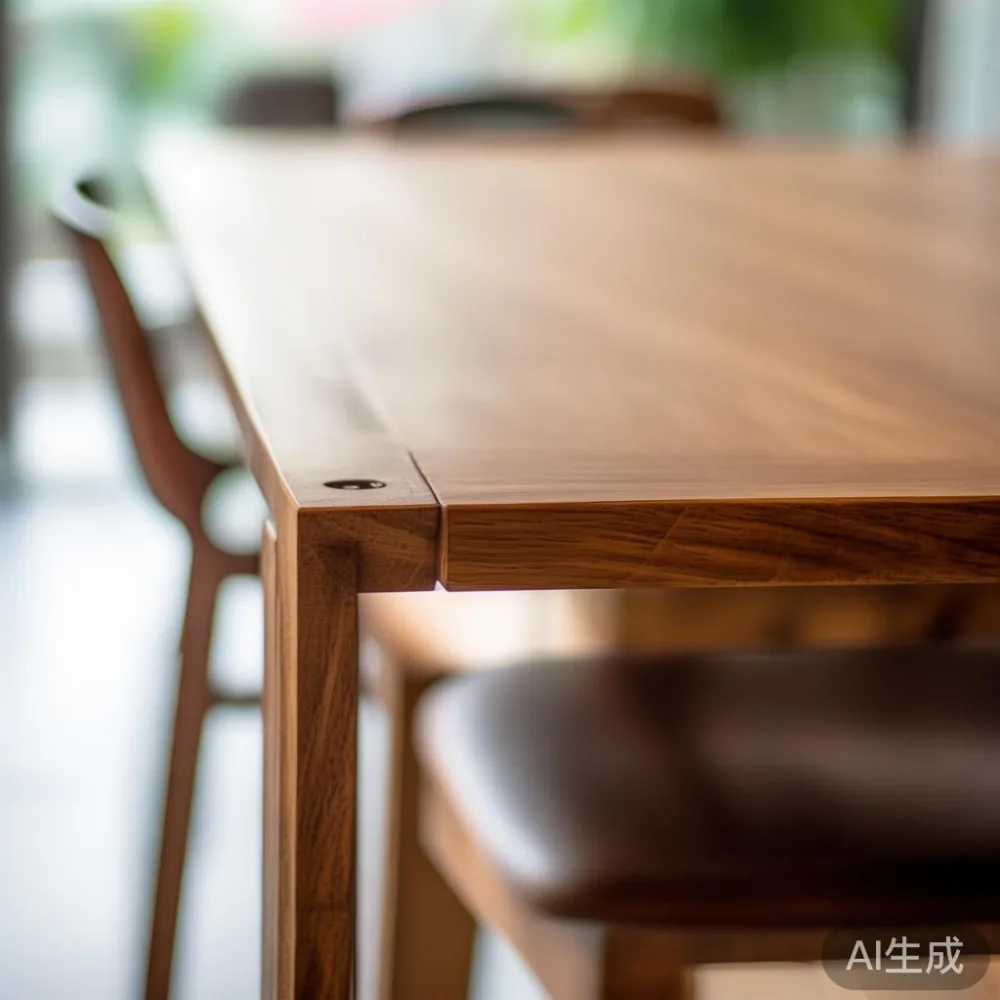
Note the table weight too. A solid-wood dining table for six in oak or ash typically weighs between 65 kg and 95 kg. Marble table tops run 80 kg to 140 kg before the base is added. If the gross weight crosses 100 kg, most Singapore freight lift operators require a protective blanket surcharge of S$40 to S$80 per trip.
Step 2: Match the Table to the Living-Dining Footprint
An HDB 4-room flat living room typically measures between 4.2 m and 4.8 m long when the dining area is open-plan to the lounge. After leaving 0.9 m clearance behind every chair — so a diner can stand, push back, and pass another person — the practical dining footprint drops by roughly 1.2 m. That leaves 3.0 m to 3.6 m of effective run.
The comfortable sizing logic works like this:
• 4-person square dining table: 0.9 m to 1.1 m side. Fits a 2.4 m x 2.4 m dining nook. Ideal for compact 3-room flats under 65 sqm.
• 4-person rectangular dining table: 1.2 m long by 0.75 m to 0.8 m wide. Works in a 2.8 m run.
• 6-person rectangular dining table: 1.6 m to 1.8 m long by 0.8 m wide. Needs a 3.0 m run.
• 6-person with two leaves or a self-extending top: 1.4 m closed, 2.0 m open. The most flexible pick for condo units in Punggol Waterway where the dining area shares the window wall.
• 8-person rectangular dining table: 2.0 m to 2.4 m long by 0.9 m wide. Only realistic in a 5-room flat (90 sqm+) or a maisonette where the void opens up.
Width matters too. Anything wider than 1.0 m steals visual breathing room and makes the room feel shorter. A 0.8 m wide top with a 0.05 m overhang on each side lands as the most balanced ratio for HDB ceilings at 2.6 m to 2.8 m.
What Shape Works Best for an HDB Living Room?
Rectangular tops dominate HDB homes because the layout is rectangular. Round tables shine in square rooms but waste corner space in a long, narrow living-dining layout. Oval tops borrow from both — soft corners, no sharp corner to crack a shin during a midnight kitchen run.
If your sofa faces the dining table directly, leave at least 1.1 m between the table edge and the sofa back. A solid wood sofa with a deeper seat at 0.95 m will need a 1.2 m gap, otherwise knees brush the table apron whenever someone stands.
Extending tables deserve a callout. A 1.4 m extending top that opens to 2.0 m handles weeknight dinners for four and CNY gatherings for eight without forcing you to commit to a giant top that vacuums dust around its legs all year. For a household that hosts 10 times a year and dines at home 300 times a year, this is the most sensible shape.
Light Luxury Direction: French, American, Italian, and Modern Picks
Light luxury in the furniture world describes restrained silhouettes dressed in tactile materials — think a slender ash base paired with a soft travertine top, or a quilted leather dining chair on a brushed brass frame. For HDB buyers, four directions tend to land well.
French light luxury leans on cabriole legs, soft curves, and warm walnut tones. It pairs naturally with a chandelier and looks at home in a Punggol EC with 3 m of ceiling height. American light luxury is more grounded: thicker legs, oak tops with visible grain, matte black hardware, and slightly oversized proportions. It handles the knocks of a household with toddlers. Post-modern light luxury mixes two materials per piece — a marble table with a brushed brass column, or a glass-topped dining table on a fluted wood base. Italian light luxury nightstand pieces share the same brass-and-stone vocabulary at bedside scale, so the dining room and the bedroom speak the same material language.
Inside the dining room itself, a Bohemian accent reads well as a softer counterpoint. Layer a Boho for dining room moment through a low-pile jute rug, a clay pendant, and a vase of dried pampas — without shifting the table itself away from its light luxury frame.
For bedroom coordination, when a buyer asks which bed frame suits the same direction, the conversation often moves toward the best Modern light luxury bed for 2026: a low-profile ash platform with channel stitching and tapered legs. Keep the wardrobe and nightstand in the same wood tone so the dining table, bed frame, and wardrobe read as one design family rather than three separate purchases.
How Much Should You Budget in SGD for a Solid Wood Dining Table?
Singapore dining table prices in 2026, based on three reference points I checked last month at furniture showrooms along Bukit Batok and online direct-from-factory portals:
• 4-person solid wood dining table, MDF-core extension: S$799 to S$1,400. Veneered, lighter weight (40 kg to 55 kg).
• 6-person solid oak or ash dining table, no extension: S$1,800 to S$3,200. Weight 65 kg to 85 kg.
• 6-person with self-extending top: S$2,400 to S$3,800.
• 8-person solid wood dining table: S$3,000 to S$5,200.
• Marble table top (Italian Carrara, 1.8 m x 0.9 m) on solid wood base: S$4,500 to S$7,800.
Add 9% GST on top of these figures. A S$3,000 table becomes S$3,270 at checkout. If the table ships from a Foshan factory by sea, expect 25 to 35 days for delivery, free over US$350 (about S$475), with a 14-day return window from the day of arrival. The 10-year structural warranty covers joint cracking and frame warping. Lifetime refinishing means a sanding and re-oiling is available at cost after the warranty period, useful for the occasional ring left by a hot pot during steamboat nights.
Buyers who want a European light luxury for apartment direction at sub-S$2,000 price points usually chase under 2000 European furniture listings during warehouse sales. Direct-from-factory supply keeps the figure attainable when the finish is a stained ash rather than a solid walnut build.
How Do You Match a Dining Table to an HDB Living Room Without Overcrowding It?
Three rules work every time:
1. Leave 0.9 m behind every chair, 1.1 m in circulation paths. Anything less and the room feels cramped.
2. Anchor the dining table with a rug sized 0.6 m wider on every side. A 1.8 m table pairs with a 3.0 m x 2.0 m rug. A 2.2 m table pairs with a 3.4 m x 2.4 m rug.
3. Keep one statement material. Marble table top OR leather chairs OR brass pendant — pick one, repeat it on a small accessory elsewhere in the room.
Which Wood and Finish Handle Singapore Humidity Best?
Singapore humidity runs between 70% and 85% for three quarters of the year. Solid wood expands and contracts with moisture, but well-seasoned pieces hold their shape. White oak and ash perform well. Rubberwood is budget-friendly but dents more easily. Walnut and cherry darken under UV light, which is worth noting for flats with large window walls facing west in Jurong or Clementi.
Finishes matter as much as species. A conversion varnish or a hand-rubbed oil both work, but lacquer finishes trap moisture and may cloud within five years if the air-conditioner runs without a dehumidifier set between 45% and 55% RH. A bedroom suite — a Scandinavian for guest room direction built on pale oak — benefits from the same humidity target, since guest rooms in HDB flats often sit unused with the door closed and trap moisture.
Delivery Day Logistics: What to Expect
My colleague who lives in a Punggol 5-room flat ordered a 1.8 m solid oak dining table last quarter. The table arrived on day 28, double-boxed with foam corners and an outer plywood crate. Two movers carried it up the service lift, unwrapped the crate in the corridor, and reassembled the base in the living room. The whole job took 45 minutes. The corridor was 1.3 m clear, the lift was 2.1 m tall, and the table went in on its side. He tipped S$20.
For tighter blocks, request a pre-delivery site survey. Reputable suppliers — including MIDHILL — will measure the lift and the corridor before shipping and flag any access issue, rather than letting you discover the table does not fit on arrival.
Care After Delivery
Wipe the dining table weekly with a damp microfibre cloth. Avoid silicone-based polishes, which leave a film that traps dust. For marble tops, seal once a year with a penetrating stone sealer, otherwise curry spills will etch the polish. Rotate extension leaves so the same end does not face the window every week, otherwise the colour drifts.
If the household includes a toddler's room, choose a table with rounded corners — a corner radius of at least 30 mm reduces the forehead bump risk dramatically.
Common Mistakes HDB Buyers Make
1. Buying a 2.2 m table for a 3-room flat. The room cannot breathe.
2. Forgetting the curtain line. A long table pushed too close to the window fights with full-length curtains.
3. Underestimating chair depth. A dining chair with a 0.55 m seat depth needs 0.7 m behind it.
4. Mixing metals. Brushed brass legs plus chrome handles plus matte black hardware makes a small room feel busy.
5. Skipping the GST calculation. A S$4,000 table becomes S$4,360 at checkout.
Quick Sizing Cheat Sheet
Room to seat: 2.4 m to 2.8 m → 4-person 1.0 m to 1.2 m table.
Room to seat: 3.0 m to 3.6 m → 6-person 1.4 m to 1.8 m table.
Room to seat: 3.8 m to 4.5 m → 8-person 2.0 m to 2.4 m table.
Round table minimum clearance: 0.9 m behind every chair. Round tables need a square room footprint to work.
Where to Source It
Local Singapore retailers stock light luxury dining tables but at a 30% to 80% markup. Factory-direct sourcing from a Foshan factory removes the middle layer and ships within 25 to 35 days by sea freight. MIDHILL, a Foshan solid wood furniture maker with 18 years of craft and exports to 15+ countries, publishes its sizing and warranty terms openly, so a Singapore buyer can match a model to a flat without visiting a showroom. The 10-year structural warranty and lifetime refinishing make the after-purchase path predictable, and free shipping over US$350 keeps the landed figure close to the sticker price.
Final Checklist Before You Tap Buy
– Lift ceiling height ≥ 2.1 m? If not, the table must ship disassembled.
– Corridor tightest corner ≥ 0.95 m?
– Dining run ≥ table length + 1.0 m clearance?
– Sofa-to-table gap ≥ 1.1 m?
– Budget includes 9% GST and a S$40 to S$80 lift surcharge if the table exceeds 100 kg?
– Delivery window 25–35 days acceptable for the household?
– Warranty terms and 14-day return window read clearly?
When every box ticks, the table fits the room and the room works for the household. That is the only definition of right size that matters for an HDB living room in Singapore.