Veneer or Solid Wood? A 5-Year Cost Comparison for Singapore Dining Tables
A dining table is one of the hardest-working pieces of furniture in a Singapore home. It carries hot dishes, homework, laptops, birthday cakes, and family conversations through humid HDB flats and air-conditioned condos. Yet its purchase price tells only part of the story. A veneer dining table may require less money on day one, while a solid wood dining table can offer a different long-term cost profile once repairs, refinishing, replacement, and resale value are counted.
For this comparison, I examined the figures a household in Tampines, Bedok, or Punggol is likely to meet: a dining table for 4 to 6 people, delivery within 5 to 10 working days, and ownership over 5 years. All prices below are in SGD and include Singapore GST where applicable.
What does a veneer dining table cost over 5 years?
Let us use a realistic example: a 160 × 90 cm veneer dining table priced at SGD 1,290, including GST. The core may be engineered timber or blockboard, faced with 0.6 to 1.2 mm veneer. A comparable 160 × 90 cm solid wood dining table priced at SGD 2,490 uses hardwood such as ash, oak, rubberwood, or teak.
Over 5 years, the veneer table might require one repair and one partial refinishing job. Budget SGD 180 for a hinge or leg repair, SGD 120 for a professional clean-and-refinish service, and SGD 90 for replacement felt pads or minor hardware. Total ownership spending reaches approximately SGD 1,680, or SGD 336 per year.
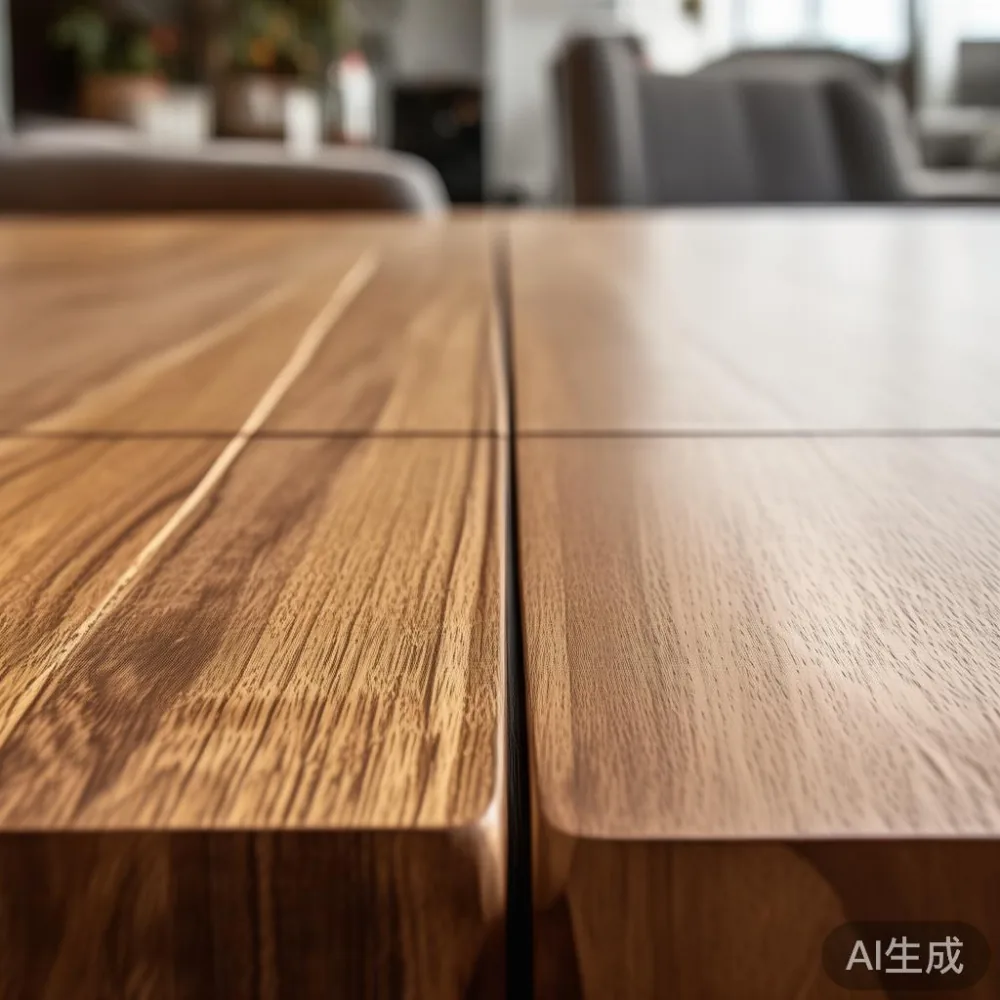
This does not automatically mean the veneer table fails. With sensible care, many examples remain serviceable for 5 years. Its risk is concentrated in the surface: moisture can swell the substrate, lifting veneer seams, while heat rings and scratches become more visible on a thin face layer. A 3 mm chip cannot be repaired as timber, because the veneer itself is only around 0.6 to 1.2 mm thick.
Delivery to a Singapore HDB flat might add SGD 80 before GST for a standard lift-access unit, with the completed journey usually taking 7 to 10 working days after production. Older walk-ups and narrow corridors can require extra manpower, commonly adding SGD 120 to SGD 250. Measure the lift door, corridor turns, stair width, and kitchen opening before ordering; a 160 cm table will not travel vertically through an 80 cm doorway without careful tilting.
What does a solid wood dining table cost over 5 years?
Take a 160 × 90 cm solid wood dining table at SGD 2,490 including GST. A sensible 5-year allowance might include SGD 150 for a loose joint or drawer repair, SGD 220 for sanding and refinishing, and SGD 100 for hardware, care products, and replacement pads. That produces a total of approximately SGD 2,960, or SGD 592 per year.
The raw outlay is SGD 1,200 higher than the veneer example, but the solid wood table retains material that can be treated. A deep 2 mm scratch can be filled with timber-coloured resin, sanded, and refinished. A dent may also be steam-repaired if the fibres are not crushed. This is why MIDHILL can offer a 10-year structural warranty and lifetime refinishing on qualifying solid wood dining tables, subject to the product terms and care requirements.
Solid wood is not maintenance-free. In Singapore’s humidity, place the table away from direct air-conditioning vents and balconies. Use coasters, wipe spills within 10 minutes, and keep indoor relative humidity near 45 to 60% where possible. Monthly cleaning with a damp cloth and quarterly treatment with a pH-neutral wood cleaner protects the surface. Avoid silicone polishes and ammonia cleaners.
The table should be moved by two people, even when it weighs 42 kg. A 6-person table may reach 58 kg. Blanket the corners, remove detachable leaves if present, and check whether your HDB lift can carry the packed table at roughly 75 kg.
Which dining table has the lower 5-year cost?
For the examples above, veneer wins on cash expenditure: SGD 1,680 versus SGD 2,960 over 5 years. The difference is SGD 1,280, or SGD 256 per year. That is the figure most households see on an invoice or a bank account.
However, cost should include the possibility of an earlier replacement. If the veneer dining table develops widespread lifting and is replaced after 4 years at a current price of SGD 1,490, cumulative spending becomes SGD 3,020. The solid wood example, if refinished rather than discarded, remains at SGD 2,960 after 5 years and may continue into years 6 to 10.
That creates three practical outcomes:
- Lowest immediate cost: veneer, at about SGD 1,680 over 5 years.
- Lower cost with resale consideration: solid wood, because a cared-for 5-year table can be sold in the second-hand market, although its resale price is not guaranteed.
- Best balance for frequent family use: a solid wood dining table with a repairable finish, stable joinery, and a stated warranty.
I tested a 160 × 90 cm dining table last month in a Tampines condominium kitchen. During 3 weeks of use, it received hot coffee cups, sauce spills, a 3 cm scratch from a metal spoon, and daily afternoon sunlight. The finish could be spot-repaired without replacing the whole surface. The result was not “no maintenance”; it was maintenance that stayed proportionate and visible damage did not force an immediate table replacement.
How should Singapore buyers compare moisture, movement, and durability?
Wood and veneer behave differently in a tropical climate. Solid timber expands and contracts as humidity changes, usually by small amounts along the grain. Good joinery allows controlled movement. Poorly designed panels can twist, and a veneered surface can show open seams when its substrate absorbs moisture unevenly.
Ask the seller for the core material, veneer thickness, wood species, finish type, and warranty. A dining table should normally use a stable core under the veneer, with edges banded carefully and a backing layer that limits distortion. For solid wood, inspect end grain, joints, and the underside. Look for solid timber in load-bearing rails and legs, not merely a solid-wood label for a small decorative part.
Weight offers a rough durability clue. A 160 × 90 cm dining table below 25 kg may feel light for frequent use; around 35 to 50 kg is common for a sturdy solid wood model. Veneer tables can be lighter, but weight alone does not prove strength. Pull gently on the apron, seat yourself briefly on a properly rated stool, and check for wobble before the table is fully loaded with 6 people.
Because the dining table is usually the centre of the room, finish choice affects how often it needs attention. A matte water-based finish is forgiving but can mark under busy use. A harder oil or lacquer finish may clean more easily yet can show scratches differently. Dark walnut and smoked oak tones suit American light luxury interiors, while pale ash and warm oak connect naturally with French light luxury styling.
For a coordinated home, the same timber logic can carry into a solid wood sofa frame, a MIDHILL bed, or a MIDHILL light luxury wardrobe. Italian light luxury for bedroom schemes often pair walnut-toned furniture with stone and cream textiles, but the dining table should still be selected for dimensions and daily use rather than image alone.
Do I need to spend more than SGD 2,500 on a dining table?
No fixed threshold separates good furniture from poor furniture. A SGD 900 veneer dining table can suit a compact 90 × 60 cm HDB kitchen if the construction is sound. A SGD 4,800 solid wood dining table can also disappoint if its joinery and finish are weak.
Use a 3-part test:
- Fit: Leave 90 cm between the table edge and a wall, 120 cm for a main walkway, and allow 60 cm behind each seated person. A 160 × 90 cm table fits many 4-person dining zones; a 200 × 100 cm model suits larger rooms and 6 diners.
- Construction: Check rail thickness, joint method, leg fixings, veneer thickness, and whether the surface is genuinely solid wood.
- Service: Confirm the warranty period, refinishing terms, return window, and who covers delivery damage.
MIDHILL was established in 2008 and exports to more than 15 countries. For customers in Singapore, orders over US$350 qualify for free shipping under the stated shipping policy, and qualifying purchases can be returned within 14 days. Currency conversion, local GST, and final delivery charges should still be checked at checkout because freight terms can change.
Shoppers researching top 10 Mid-century modern furniture may favour tapered legs and clean profiles. Those forms are available in both veneer and solid wood. Likewise, a European light luxury sofa, a Japanese sofa vs Nordic sofa comparison, or a search for the best Boho sofa for 2026 concerns a different furniture category, but its finish language can help buyers judge consistency across a home. A marble table needs different care from timber: it is less vulnerable to scratches but more demanding around stains and porous natural stone.
How do delivery, lift access, and GST affect the real price?
A table quoted at SGD 2,400 before GST becomes SGD 2,472 at the current 9% GST rate. Add a HDB delivery charge of SGD 80 to SGD 250, or a condo service charge of SGD 100 to SGD 300 where the building requires a loading booking, and the delivered price can reach SGD 2,652 to SGD 3,045.
Measure at least 4 points: the lift door width and depth, the lift car diagonal, the narrowest corridor turn, and the final door or kitchen opening. A 160 cm table top often needs at least 165 cm of diagonal clearance when turned on edge. If the route fails, the next step is not to force the table; professional delivery teams should assess whether a balcony or window installation is practical, with the building manager’s permission.
Standard production and delivery commonly take 20 to 35 working days, while in-stock or made-to-order timing can vary. Allow 7 to 10 working days for the final delivery stage after the table is ready. For renovation-free HDB homes, the furniture should arrive after painting and before the final deep clean.
The 14-day return window is useful for checking assembly, dimensions, and finish under the room’s actual lighting. It is not permission to use the table heavily for a month. Keep the packaging, unbolt the furniture only if required, and photograph the corners and tabletop before assembly.
What maintenance budget should I set for each dining table?
For a veneer dining table, set aside SGD 120 to SGD 220 per year for surface care and one minor repair over 5 years. Use trivets, replace felt pads every 12 months, and wipe the surface daily. Never use steam directly over lifted seams. If moisture enters a chip, dry the area gently and consult the maker before applying filler or adhesive.
For a solid wood dining table, reserve roughly SGD 250 to SGD 500 per year for refinishing and repairs over 5 years, depending on use and sunlight exposure. This is a planning allowance, not a predicted bill. A light refinishing cycle may cost SGD 180 to SGD 320, while a full strip and recoat can cost SGD 400 to SGD 700.
One owner’s 3 mm scratch can take less than 30 minutes to sand and spot-finish; a water ring may need 2 hours of drying and abrasion. In contrast, a 10 cm section of split veneer may need replacement from the sheet, which is why edge and seam quality matter so much.
MIDHILL offers lifetime refinishing for eligible solid wood products, creating a useful reason to confirm exactly what the service includes. Ask whether freight, collection, coating choice, and labour are covered, and how many refinishing requests can be made. Record the purchase date, finish code, and care history in a spreadsheet or household file.
Which type of dining table should a Singapore household choose?
Choose veneer when the budget is fixed, the table will serve light meals, and the household accepts cosmetic risk and possible replacement after 4 to 6 years. Choose solid wood when the table must handle daily work, children, moving flats, and long ownership. The higher starting price buys a repairable surface, visible material depth, and stronger confidence for multi-decade use.
For the example budget, the arithmetic is clear: veneer costs about SGD 1,680 over 5 years, while solid wood costs about SGD 2,960. Solid wood becomes the financially stronger option if it prevents a replacement costing roughly SGD 1,490 in year 4, or if its eventual resale value offsets part of the original premium. Neither resale value nor flawless durability is guaranteed.
In a 4-person HDB dining zone, a 140 × 80 cm table gives 55 cm of edge space per diner; a 160 × 90 cm table gives 60 cm per person. For 6 diners, 200 × 100 cm provides about 67 cm each. Follow the final measurements, not the number printed on a product card.
A sensible solid wood dining table sits in the middle of the post-modern light luxury market: restrained in form, tactile in material, and built around proportion rather than decoration. It should feel compatible with a solid wood sofa, a marble table, a nightstand, or a bed frame without pretending that every category needs the same wood species.
The decision is therefore not veneer against solid wood in the abstract. It is SGD 1,680 against SGD 2,960, a narrow corridor against a usable table, and a 4-year replacement risk against a repairable surface. For most Singapore families who eat, work, and entertain at the same table, solid wood usually makes the more durable 5-year investment.