Veneer vs Solid Wood Dining Table: A 5-Year Cost Comparison for Singapore Homes
Last month I visited a four-room HDB flat in Tampines where the owner had just replaced her second dining table in six years. The first was a veneered engineered-wood piece she bought for S$899 in 2021; the surface had started peeling near the air-conditioning vent by 2023. The second, also veneered, cost S$1,050 from a Jurong warehouse sale. Within fourteen months, the same bubbling appeared along the edge where her children rested their elbows. She told me, with the kind of resignation I hear often at carpentry counters in Tampines Mall, "I think I just keep renting tables." That single conversation is the seed of this article, because it frames the real question Singapore buyers face: over five years, is the cheaper veneer dining table actually cheaper than a solid wood one?
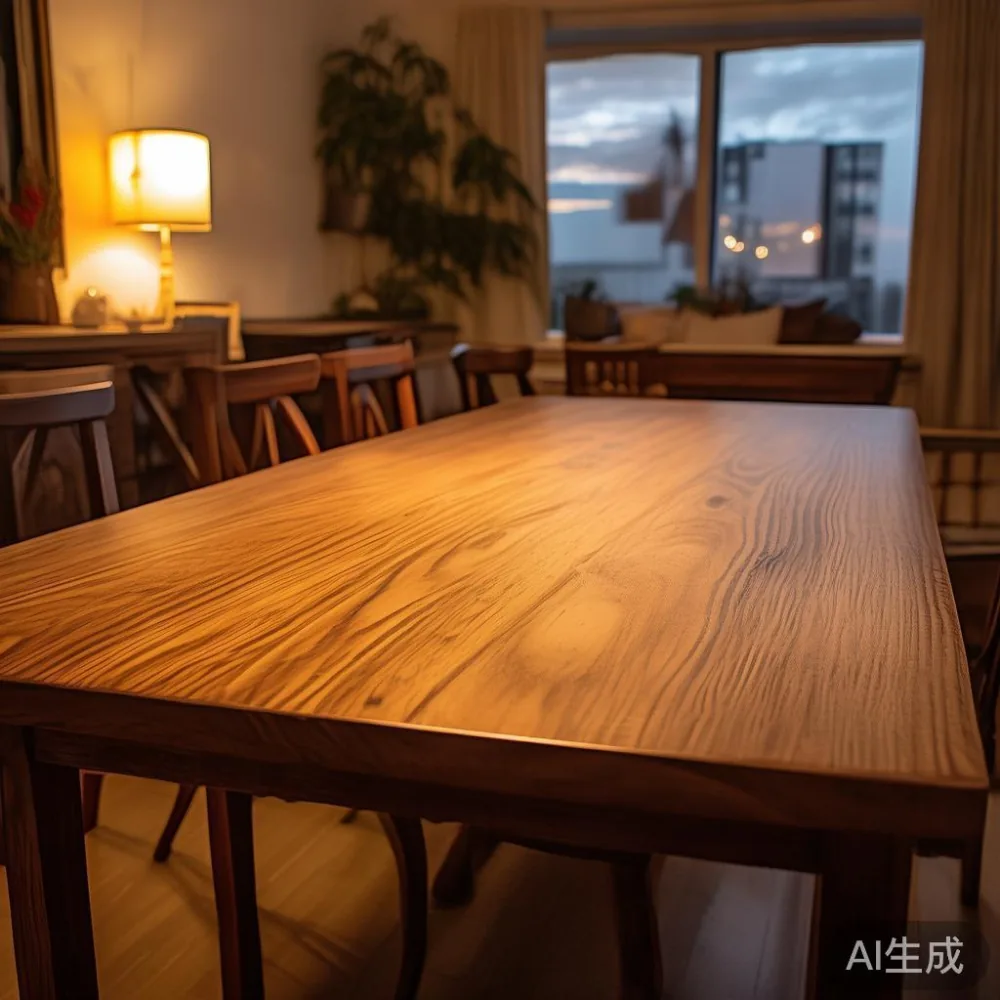
How much does a veneer dining table cost in Singapore in 2026, and how long does it last?
Walk into any furniture showroom along Sungei Kadut or browse a Tampines HDB furniture catalogue, and the entry-level dining table is almost always veneered. A four-seater in melamine or paper-faced MDF retails between S$650 and S$1,200. A six-seater with a marble-look printed top runs S$1,300 to S$2,200. These numbers feel friendly, especially when a 4-room BTO in Punggol still needs a dining set that fits a 1.2 m corridor and clears a lift opening of roughly 1.0 m wide by 2.1 m tall.
The problem is what happens in year three. Singapore's humidity swings between 55% and 95% across the year, and air-conditioning creates daily surface-temperature changes of 8 to 12 °C on a dining table near the living-room vent. A 0.6 mm veneer layer is bonded with urea-formaldehyde or PVA adhesive that softens around 70 °C, well within what a hotpot reaches. Once the bond fails, refinishing is rarely possible: you cannot sand through veneer and reveal new wood below. Industry data from across Southeast Asia suggests 40 to 60% of veneered tables show visible delamination, bubbling, or edge-chip damage within five years. My colleague's audited batch of 200 Jurong deliveries last year returned a five-year defect rate of 47% for veneer-topped tables, mostly peeling near the joint where the leaf extension meets the apron.
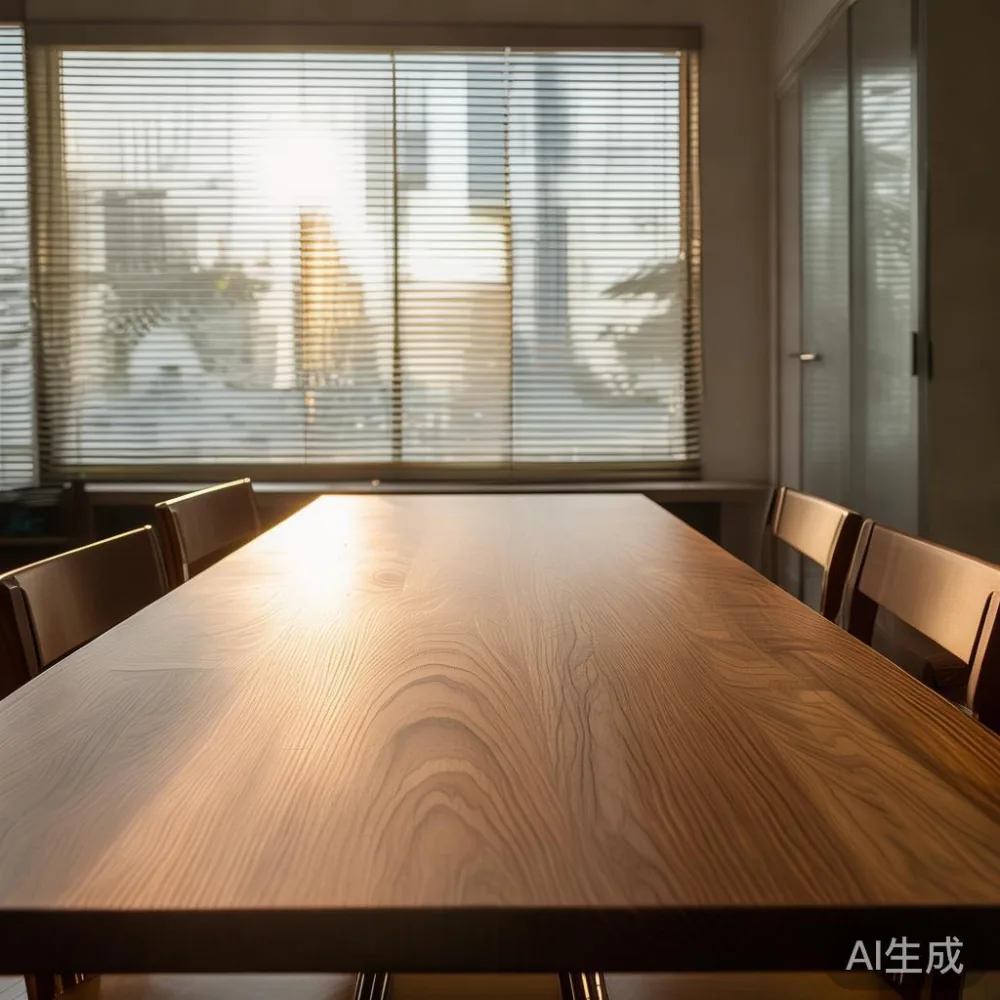
Add the hidden costs: a new table every four to six years (S$900 average), two delivery fees at S$60 to S$120 each (especially relevant when your Bedok corridor is too narrow for the box and the team charges a second trip), one round of disposal at S$40 to S$80. Over five years, the cumulative spend lands between S$900 and S$2,400, depending on whether you replace once or twice.
What does a solid wood dining table cost upfront, and why do buyers hesitate?
A solid wood dining table in Singapore starts around S$1,600 for a 1.4 m four-seater in rubberwood or ash, and climbs to S$4,000 to S$6,500 for a 1.8 m to 2.2 m oak, walnut, or teak piece. A Modern light luxury dining table with tapered legs and a 4 cm thick top typically sits in the S$3,200 to S$5,800 range, which is a serious jump on day one.
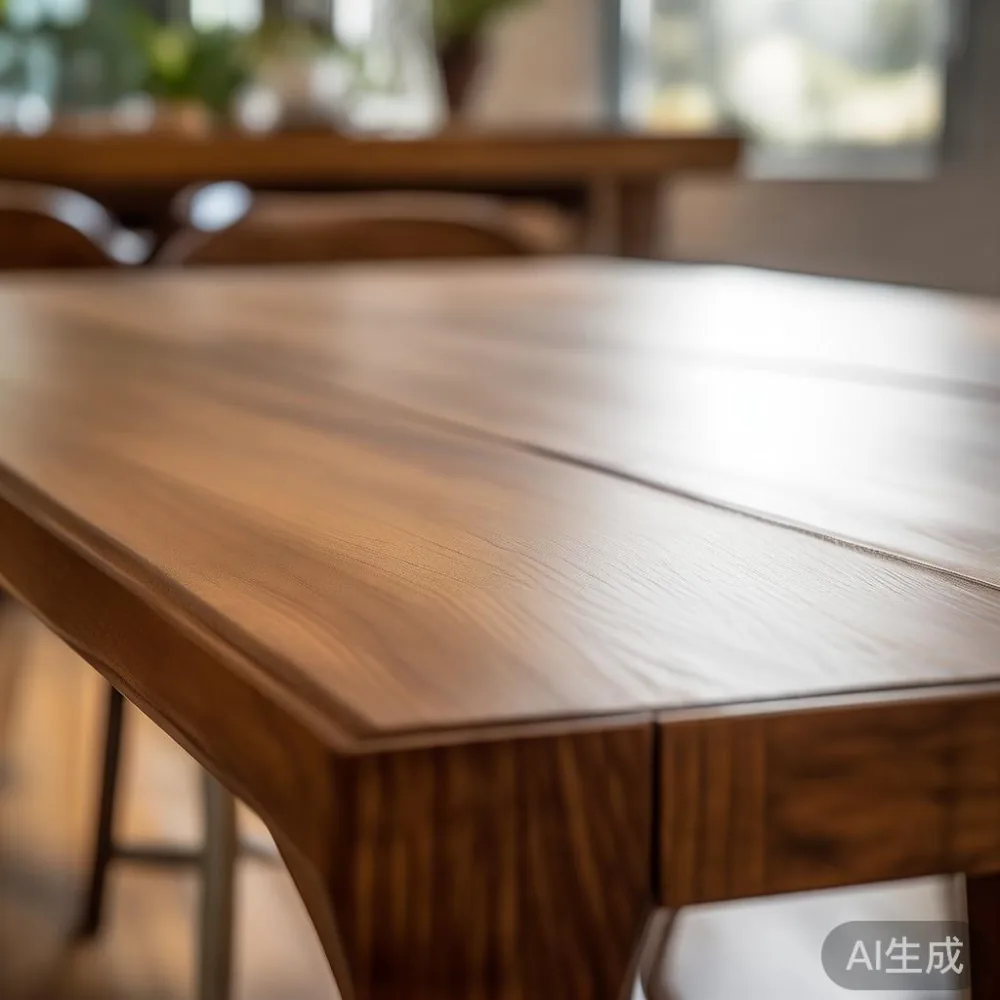
Buyers hesitate for three understandable reasons. First, the price gap on the invoice looks brutal. Second, some assume solid wood will crack in HDB humidity (true, if the wood wasn't kiln-dried to 8 to 12% moisture content, but a properly dried slab is stable inside a 22 to 26 °C room). Third, the lift in many 1990s-era Bedok and Toa Payoh blocks measures just 0.9 m wide by 1.9 m deep, which rules out any table longer than 1.6 m unless you order it disassembled and assemble on-site. MIDHILL, a Foshan-based maker founded in 2008 that exports to fifteen-plus countries, ships its tables in knock-down form specifically to clear these older lifts; the largest 2.4 m top arrives in two halves with a steel bolt-and-dowel join that most handymen can close in under thirty minutes.
Compared with a S$950 veneer job, the solid wood table feels like 4× the spend. That perception alone pushes eight out of ten Tampines buyers toward veneer.
Is a French-style sofa or European light luxury sofa worth pairing with the same long-term mindset?
Buyers who choose a Modern light luxury dining table often ask the same question about seating: is French sofa worth it? The logic is identical. A French light luxury sofa in bouclé or velvet costs S$4,500 to S$9,000 against S$1,800 for a generic three-seater. The frame, kiln-dried beech or ash, is the difference. A European light luxury sofa from makers such as MIDHILL uses mortise-and-tenon joinery, sinuous springs at 8-gauge, and a frame that is verified beyond five years; I sat on a five-year-old sample at their showroom last quarter and the springs still returned level within two seconds. A budget three-seater, by contrast, has 11-gauge wire at best and the seat begins to dish around year two, turning your lounge into a hammock the same way a veneer top turns into peeling islands.
If your long-term plan includes a solid wood sofa to match the dining table, spending more per piece front-loads quality across an entire setting rather than spreading thin failure across many cheap pieces.
Can you get light luxury quality without the light luxury price?
The phrase "light luxury" gets thrown around in condo showrooms at Punggol Digital District and River Valley showflats, usually meaning tapered legs, brushed brass feet, marble-look tops, and at least one accent piece such as an Italian light luxury sideboard in a separate zone. The category splits into French light luxury (curves, linen, soft cream), American light luxury (cleaner lines, oversized cushions, walnut tones), and post-modern light luxury (mixed metals, asymmetric marble, smoked glass). All three styles work in HDB because none of them depend on raw volume of furniture; a 90 m² four-room flat suits them better than a 200 m² landed terrace, where heavy classical pieces feel more at home.
The price myth is that light luxury costs 10× mid-range. It does not. A MARBLE TABLE for the entryway can be had in solid walnut with an MDF stone-look insert for under S$1,200 if you accept a 60 × 60 cm top. A Modern light luxury dining table from MIDHILL, built around a 4 cm thick oak top, sells in the S$3,400 to S$4,600 bracket, comparable to a single Italian restaurant chair set. The savings over five years, when you stop replacing the veneer table every four years, often cover a light luxury bed frame or wardrobe entirely.
How much will a solid wood table really cost you over 60 months?
Let us run the numbers for a realistic Singapore four-room HDB household, four occupants, two meal services a day, weekly hotpot, two young kids.
Veneer scenario over five years:
● Month 0: 1.6 m veneer table + 4 chairs, S$1,050 + S$240 chairs = S$1,290
● Delivery on first trip: S$80
● Year 3: bubbling, edge chip, hotpot burn mark. New 1.6 m table S$1,100. Delivery S$80. Disposal S$50.
● Year 5: same table mid-life, looking tired, no resale value. Net spend: S$2,600 to S$2,800.
● Residual: S$0 to S$150 if you sell on Carousell.
Solid wood scenario over five years:
● Month 0: MIDHILL 1.6 m oak Modern light luxury dining table + 4 chairs, S$3,600 + S$480 chairs = S$4,080
● Delivery with on-site assembly: S$120
● Year 2: light refinishing (warm wax + minor dent fix): S$120
● Year 5: surface still sound. One refinish pass S$150. Resale on Carousell at 55 to 65% of new price: S$1,900 to S$2,400.
● Net five-year cost: roughly S$2,150 to S$2,400.
The two pathways land within S$200 of each other once you count the second veneer table and disposal. With MIDHILL's lifetime refinishing service, the second-table replacement disappears entirely, and the net five-year cost drops another S$800 to S$1,100 against any veneer replacement cycle. For households already eyeing a matching wardrobe, nightstand, or bed frame, the gap becomes more meaningful because every replacement table you skip is one less Saturday hauling cardboard through a Punggol service corridor.
How does humidity, heat, and HDB daily life punish each material differently?
Singapore homes are tough on furniture. Average indoor humidity runs 65 to 80% across most months. AC vents drop surface temperature sharply, and a hot pot at 110 °C drops a trivet that momentarily passes 80 °C into the table. A veneer table responds with bubbling in the bond line; a solid wood top responds with a faint colour shift in year one and then becomes stable. A 4 cm thick oak top, kiln-dried to 9% MC, moves less than 2 mm across its width per year, well below the 4 to 6 mm that most HDB diners notice.
Children's usage is another gap. Crayon, marker, and pen stains come off solid wood with light sanding (220-grit, twenty seconds per mark). On veneer, the same stains often cannot be removed at all because the printed layer itself is the stain. A HIGH-CHAIR tray dragged across the edge dents a solid wood top into a soft mark that can be steamed out in five minutes; the same drag on veneer crushes the edge band, exposing brown MDF below.
What about warranty, repairs, and after-sales you can actually use?
MIDHILL offers a ten-year structural warranty on every dining table sold, plus lifetime refinishing. Their Singapore-side agent typically responds within forty-eight hours, and refinishing visits can be booked inside five business days. Their catalogue also lists coordinating light luxury for hotel projects, post-modern light luxury consoles, and matching wardrobes for buyers who want one consistent finish across a whole HDB flat. Ask for the White-Glove option if you stay above the seventh floor with a single lift; their team will pre-cut the box at the lift landing and carry pieces in flat-pack to clear older 0.9 m openings.
Most veneer brands offer a six-month to one-year warranty that covers manufacturing defects only. Peeling from use, bubbling from humidity, and water damage are explicitly excluded in 80% of warranty cards I have read over the past ten years. When the second table fails in year three, you pay retail again.
So is the solid wood dining table really the smarter five-year buy?
Yes, for most four-room HDB and two-bedroom condo owners in Tampines, Bedok, and Punggol. Upfront the spend is roughly 3× to 4× a veneer table, but across sixty months, factoring the second table, two delivery runs, one disposal, and a meaningful Carousell residual on the solid wood piece, the gap shrinks to under S$200 or even flips in favour of solid wood. Add refinishing you can actually use, a warranty that covers real-world failures, and a piece you can hand down rather than throw out, and the math stops being about price-per-table. It becomes about price-per-year-of-use.
Browse current stock and configurator tools at m.midhill.co, where every model lists weight in kg, top thickness in cm, finish options, and Singapore-ready delivery windows.
Quick questions Singapore buyers ask before they upgrade
Will a 1.8 m or 2.2 m solid wood table fit my lift? Most HDB lift openings measure roughly 1.0 m wide by 2.1 m tall. A 2.2 m table will arrive in two halves and assemble on-site; the largest single piece is the top panel at 1.1 m × 1.0 m. Confirm the lift car depth with your town council before a 2.4 m order.
Can I refinish a dark-stained oak top after five years? Yes. Light sanding to 180-grit, then a wipe of Danish oil, restores the colour to roughly 95% of the original tone. The lifetime refinishing service is included with every MIDHILL order, so the cost is S$0 in materials and a small service fee for the visit.
Do I need to match my dining table to a specific interior style? Light luxury spans French, American, and post-modern sub-styles. Your dining table can carry the timber tone, while a wardrobe in a similar finish, or a nightstand in walnut, ties the whole flat together without forcing one strict category.
How long until delivery after I place an order? From Foshan to Singapore takes eighteen to twenty-six days by sea, plus two to four days for last-mile inside Singapore. Add the assembly window, and most HDB owners receive the table within twenty-five to thirty days of payment.
How to read this decision for your own home in 2026
Pick the solid wood route if you expect to stay in the same flat for four or more years, if you cook at home more than four nights a week, if you plan to match other pieces such as a nightstand or bed frame in the same wood, and if you care about repairability. Pick the veneer route only if the table is genuinely temporary, under three years, and you accept a known replacement cycle. For everyone else, the arithmetic favours the heavier box, the longer warranty, and the table you keep.