Veneer vs Solid Wood Dining Tables: What 5 Years in a Tampines HDB Actually Costs
Last month I visited my colleague Priya's new 4-room BTO in Punggol. She had just bought a glossy dining table from a big-box retailer in Tampines for S$899, and within fourteen months the edges near the air-conditioning vent were already bubbling and lifting. The core was particleboard wrapped in a thin oak-look veneer. By contrast, my aunt's 2014 solid teak dining table in her Bedok resale flat still gets sanded and oiled every Chinese New Year, and the children of the family have done homework on it for a decade. That single visit prompted this 5-year cost comparison between veneer and solid wood dining tables in Singapore dollars, written for HDB and condo owners in Tampines, Bedok, Punggol, and the wider East Coast.
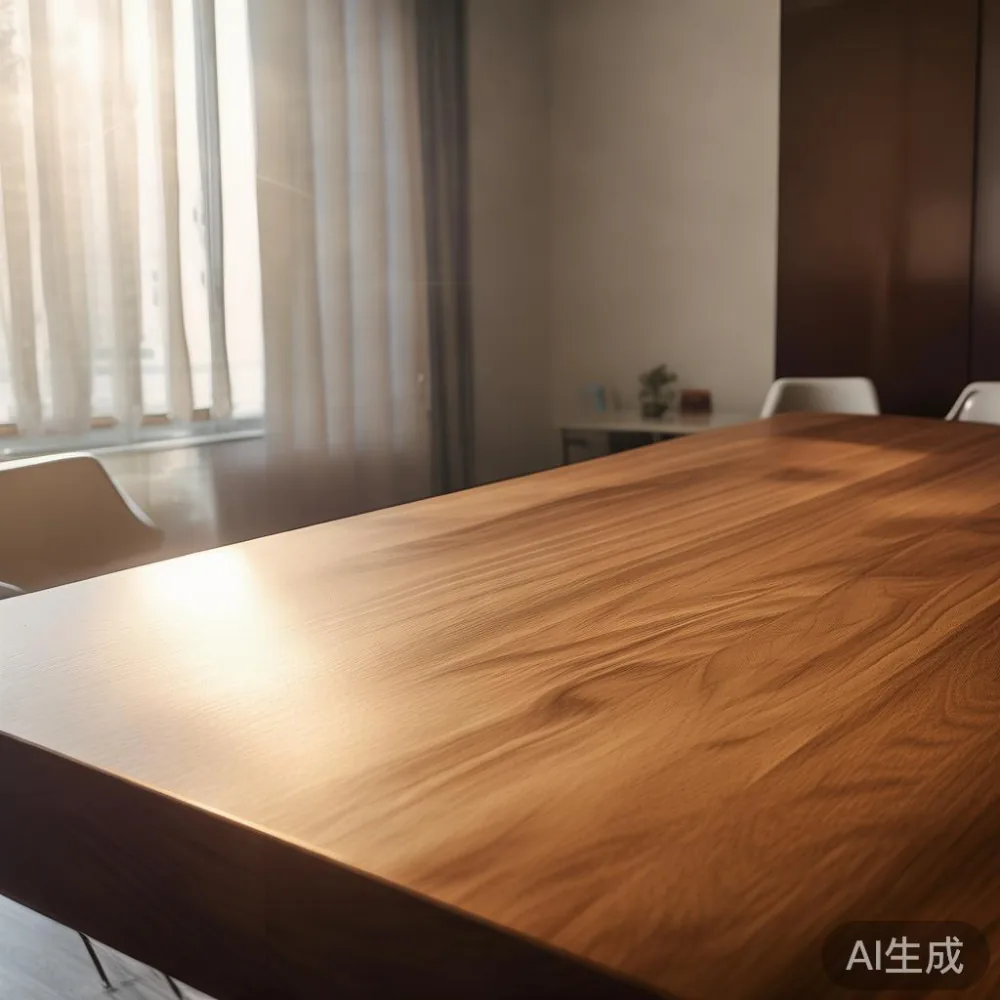
Why Singapore humidity punishes the wrong dining table
Our island sits one degree north of the equator, with average relative humidity hovering between 70 and 85 percent for most of the year. A dining table lives directly under that humidity load, and it also absorbs cooking steam, the condensate from an open kitchen, and the sudden swings of a 24-degree air-conditioned room. Engineered wood products built around MDF, particleboard, or thin veneer expand and contract with every change. Edges lift, corners delaminate, and joints loosen around the apron where the legs meet the top. A solid wood dining table moves too, but the movement is distributed across the full thickness of the timber, so it stays serviceable for decades.
MIDHILL has been making solid wood dining tables out of its Foshan workshop since 2008, and one of the more common questions from Singapore buyers is whether the extra up-front spend is really worth it when a S$600 veneer option looks identical on Day One. The honest answer is that Day One is precisely when the two products are at their closest. By Year Three the gap is visible, and by Year Five it shows up on the invoice.
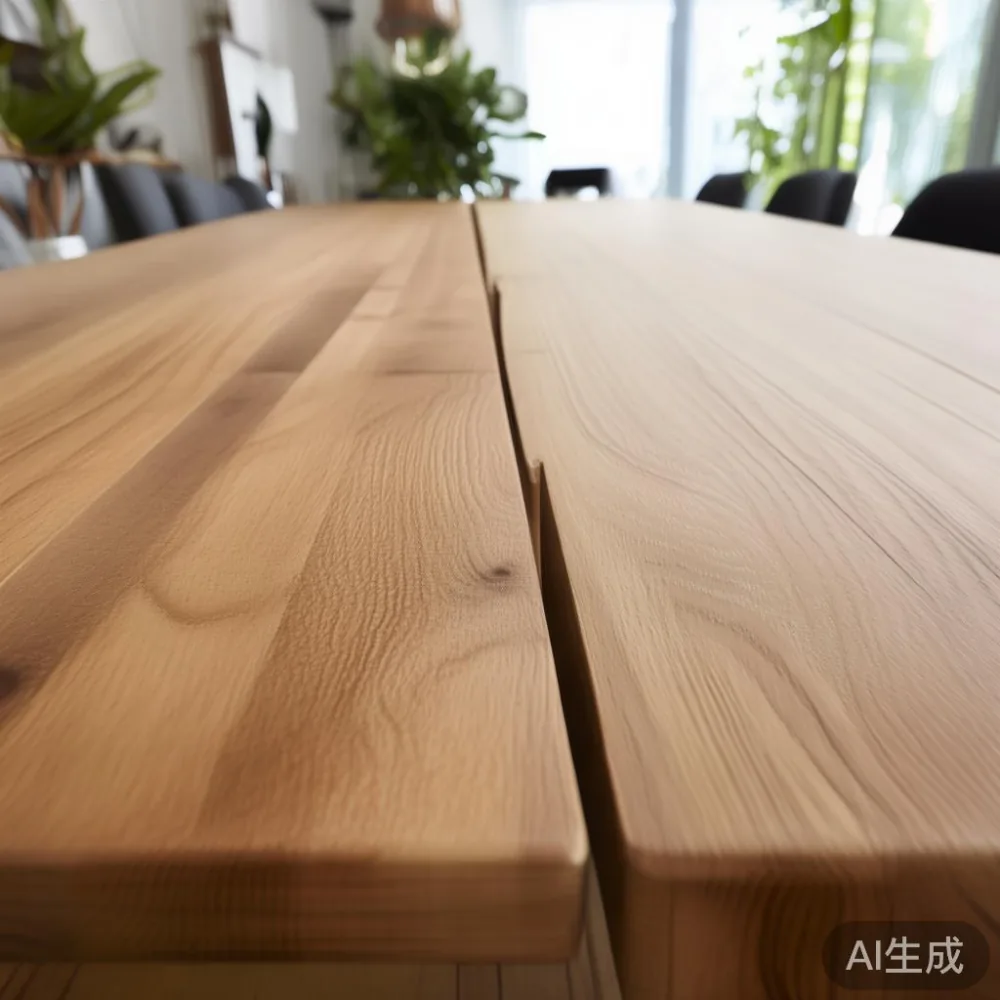
The real 5-year cost of a veneer dining table in SGD
Let us anchor this with concrete numbers. A typical 1.4m veneer dining table from a Tampines mall retailer costs around S$750 to S$1,200 delivered. The same specification in solid ash or solid walnut sits in the S$1,400 to S$2,400 range, depending on edge profile and base design. Singapore's 9 percent GST applies to both.
Year 0: S$850 for the veneer table, S$1,650 for the solid wood equivalent. Both arrive flat-packed or assembled, depending on whether your corridor can accept a 140 cm carton (a standard 4-room HDB corridor is around 1.2 m wide and most service lifts are 1.0 m by 1.4 m, so disassembly is usually required either way).
Year 1 to 2: Free replacement screws and one tightening session, if the brand honours the warranty. Most big-box warranties exclude humidity-related warping.
Year 3: Edge lifting near the kitchen zone. Local repair shops in Geylang or Ubi quote S$120 to S$250 to re-bond and re-veneer a swollen edge, and the colour match is rarely perfect.
Year 4: One leg joint loosens because the dowel hole has ovalised. A carpenter charges S$80 to S$150 to reglu and peg the joint.
Year 5: The top has visibly crowned or cupped. The table wobbles even on a level floor. Most Singapore families at this point either commission a full re-top (S$350 to S$600) or replace the table entirely. Cumulative spend, including the original purchase: roughly S$1,350 to S$2,000 over five years, with the table still underperforming its original specification.
The solid wood dining table, by contrast, costs S$1,650 at Year 0 and zero at Years 1 through 4. A light sanding and a fresh coat of hardwax oil in Year 5 runs S$120 to S$200 if you hire a mobile refinisher, or it is free if you do it yourself on a Saturday afternoon. Cumulative spend: S$1,770 to S$1,850, with a surface that looks better than new.
How do I style a Italian light luxury sofa in a small apartment?
Keep the sofa in a warm off-white or stone grey, pair it with a slim black walnut or marble side table, and let one sculptural lamp do the heavy lifting in the corner, so the room reads curated rather than crowded.
That short answer carries through to the dining zone. In a 90 sqm Punggol flat, the dining table is the visual anchor, and a solid wood top in ash or walnut reads as quietly expensive in a way that a printed veneer cannot fake under raking afternoon light. If you already own an Italian light luxury sofa in the living room, repeat the same warm timber tone at the dining table so the two zones feel like one continuous decision rather than two separate purchases. The same logic applies if you have an American light luxury sofa in cream boucle: a 1.4 m ash dining table with a soft chamfered edge keeps the silhouette light and prevents the flat from feeling like a furniture showroom.
What about delivery, lifts, and HDB access rules?
This is a Singapore-specific cost that buyers in JB or Kuala Lumpur rarely think about. A 1.4 m solid wood dining table in a single carton will not fit into most HDB service lifts, which have a door width of roughly 0.9 m and a cabin depth of 1.4 m. Two workable solutions exist. The first is flat-pack knock-down assembly on site, which adds 30 to 60 minutes of build time and a S$40 to S$80 assembly fee if you outsource it. The second is a fully assembled table with a detachable leg system that slots into a smaller carton, which is the approach MIDHILL takes for its Singapore-bound dining table shipments.
For Nordic ash wood assembly difficulty in particular, expect a straightforward job: eight through-bolts, four corner blocks, one Allen key, and roughly 25 minutes for one adult. The ash is softer than walnut, so do not over-torque the bolts or you will crush the threads. Walnut and white oak ask for slightly more care because of the higher density, but the assembly principle is identical.
Free shipping thresholds also matter. Most Singapore retailers offer free delivery above S$350 to S$500, which means the dining table on its own almost always qualifies. Condo deliveries that require booking a cargo lift or a loading bay slot can add S$30 to S$80 in coordination fees, which is worth asking about before you click checkout.
Solid wood beyond the dining table: what the same budget protects
A dining table is rarely the only timber purchase in a Singapore household. The same S$1,650 that buys one solid wood dining table would also buy a solid wood bed frame, a two-door wardrobe, and a pair of nightstands from a Foshan direct workshop, provided you buy them as a set. Buying them as a set also lets you repeat the same timber tone across the flat, which is the easiest way to make a 4-room HDB read as a designed space rather than a collection of mismatched pieces.
A solid wood sofa frame, by the way, sits underneath the cushions of almost every credible light luxury sofa on the market. Italian and American light luxury brands typically use kiln-dried beech or ash for the inner frame, then wrap it in goose down and either top-grain Italian leather or a performance boucle. The visual difference between that and a flat-pack sofa is felt within the first year, when the cushions of a cheaper sofa begin to sag and the frame starts to creak on the way to the kitchen.
If you entertain often and the marble table in the living room is already your showpiece, a solid ash or walnut dining table is the quieter supporting actor that lets the marble do the talking. If the marble table is over budget, a solid wood dining table with a subtle live edge is the more forgiving choice for daily family life.
The break-even math, side by side
Here is the comparison in a single block of SGD figures that a Tampines or Bedok buyer can copy into a spreadsheet:
Veneer dining table, 5-year cost: S$850 initial, S$200 edge repair Year 3, S$120 joint repair Year 4, S$400 replacement top Year 5. Total: S$1,570. Resale value at Year 5: S$0 to S$80. Net cost of ownership: S$1,490 to S$1,570.
Solid wood dining table, 5-year cost: S$1,650 initial, S$0 Years 1 to 4, S$150 refinishing Year 5. Total: S$1,800. Resale value at Year 5: S$700 to S$900 on Carousell or via the original workshop's trade-in. Net cost of ownership: S$900 to S$1,100.
The crossover point lands somewhere between Year 4 and Year 5, depending on how aggressively the veneer table fails and how patiently you refinish the solid wood one. Beyond Year 5 the gap widens, because the veneer table is now on its second life while the solid wood dining table is just entering its third decade.
Is a solid wood dining table worth the extra S$800 on Day One?
Yes, for any household that plans to stay in the same HDB or condo for more than three years, because the per-year cost of a solid wood dining table works out lower than the per-year cost of a veneer one once refinishing and resale are factored in.
That is the sentence most Singapore buyers can quote back to a partner who is staring at two price tags in a Tampines showroom. The math holds up at S$1,400 to S$2,400 for the solid wood option and S$750 to S$1,200 for the veneer option, because the failure modes on the cheaper product are predictable and priced.
What a Singapore-friendly warranty actually looks like
Watch for three clauses in any warranty document, regardless of brand. First, the structural warranty should cover frame joints and load-bearing components for at least five years, and ideally ten. Second, the warranty should explicitly cover humidity-related movement within normal Singapore ranges, which most exclude. Third, there should be a refinishing or replacement program that does not require you to ship a 1.4 m table back to the country of origin. MIDHILL, for one, offers a 10-year structural warranty on its solid wood dining tables and a lifetime refinishing service that is accessible from Singapore through consolidated sea-and-truck routes out of Foshan. Shipping over US$350 is free, which converts to roughly S$480 at current rates, and a 14-day return window protects the buyer if the timber tone does not match the rest of the flat under actual daylight.
Those three clauses matter more than the brand name on the brochure, because the warranty is the only document that travels with the table for the next ten years.
Final practical checklist before you click checkout
Measure the service lift in your HDB block or the cargo lift in your condo, including door width, cabin depth, and ceiling height. Confirm whether the dining table ships assembled or in knock-down form, and what the on-site assembly fee is if you cannot do it yourself. Ask for the exact timber species in writing, not just "solid wood", because solid rubberwood and solid ash are priced and perform very differently. Check whether the brand offers GST-absorbed pricing or whether the 9 percent is added at checkout. Finally, photograph the underside of the table on arrival and keep the serial number with your warranty card, so any future refinishing claim is processed in days rather than weeks.
A dining table is the one piece of furniture the whole family touches every day, from the morning kaya toast to the late-night homework session. Choosing solid wood over veneer is a small decision on Day One and a large saving by Year Five, and it is the one furniture purchase where the Singapore climate actually rewards you for spending a little more.