Solid Wood vs Veneer Dining Table: A 5-Year Cost Reality Check for Singapore Homes
Last month I visited a friend in Punggol who had just moved into a 4-room HDB BTO. She stood in her empty dining area, 2.8 metres wide, staring at a flat-packed box, and asked me the question I get asked more than any other in this line of work: "Should I spend more on a solid wood dining table, or will a veneered one survive long enough to justify the savings?" We pulled out her phone, did the maths together, and the numbers surprised her. They tend to surprise people. Over five years, the choice between a veneered dining table and one built from solid wood is rarely as obvious as the price tag suggests — especially when you factor in Singapore humidity, HDB lift dimensions, GST, and the reality of how long each piece actually lasts.
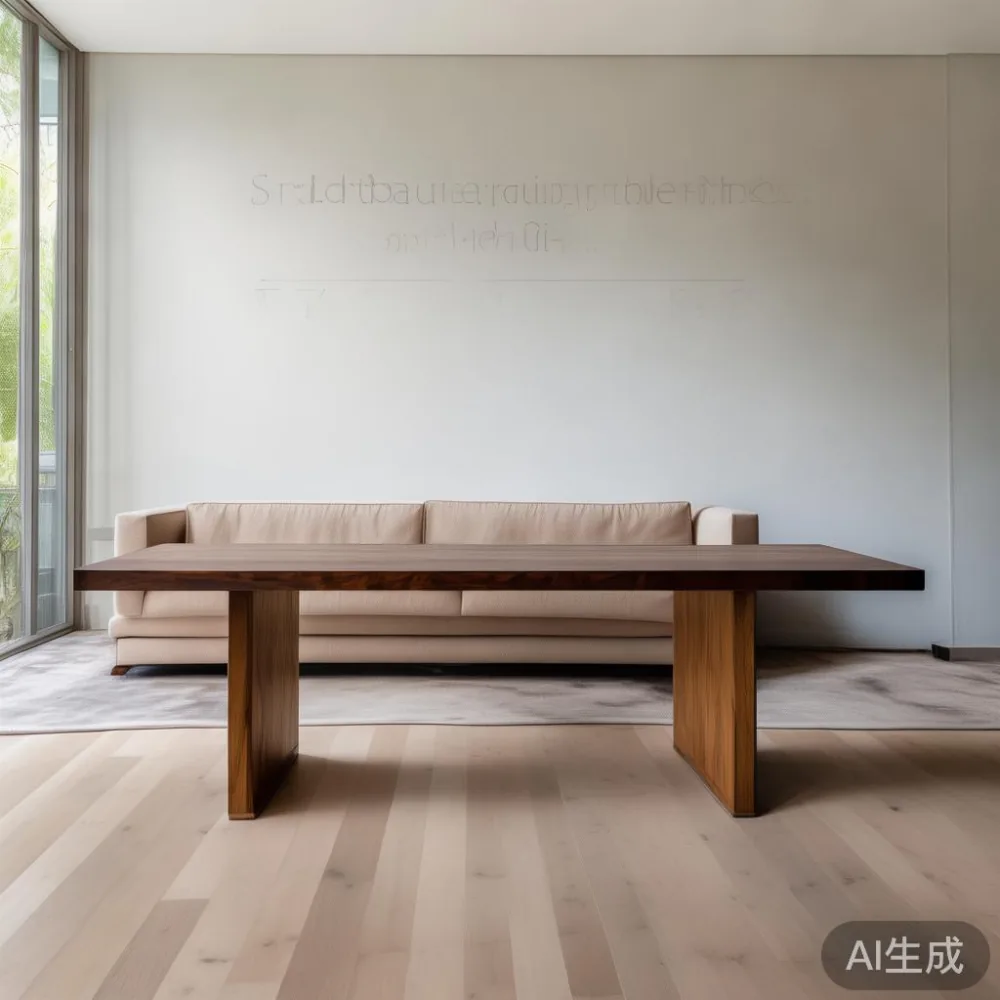
This is a head-to-head I run through with customers almost weekly at the showroom. Both options have a place. But when you do the long-term cost work, the gap between them narrows quickly, then flips. Let's walk through it with real SGD figures, real timelines, and real HDB logistics.
The Honest Starting Price: What You Actually Pay in Singapore
A decent veneered dining table from a local megastore or a regional e-commerce platform in Singapore typically lands between SGD 350 and SGD 900 for a four-seater, and SGD 700 to SGD 1,400 for a six-seater that fits a typical HDB dining area. These tables are usually an MDF or particleboard core wrapped in a 0.3 mm to 0.6 mm decorative laminate or real timber veneer, often shipped from Johor or Shenzhen, delivered in two flat-pack boxes.
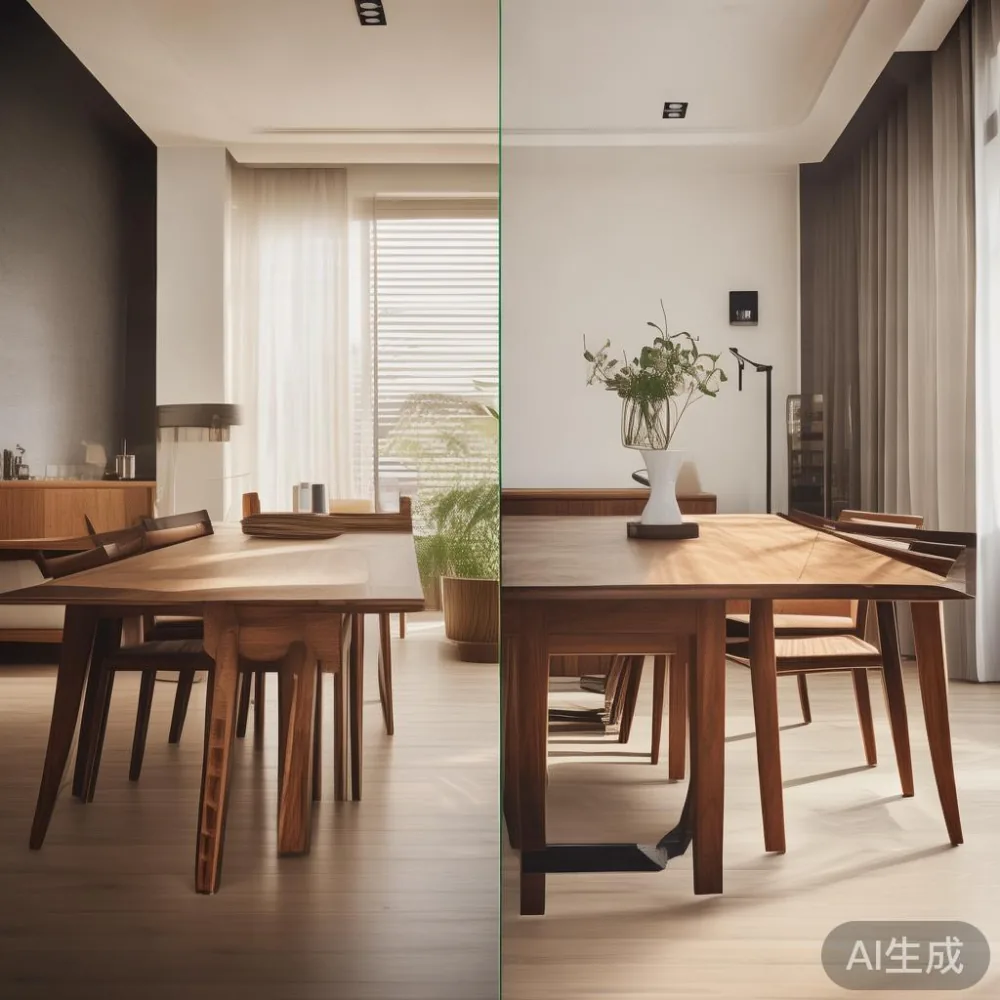
A comparable solid wood dining table in oak, ash, or rubberwood from a Foshan manufacturer such as MIDHILL — a Foshan solid wood furniture maker operating since 2008 — sits between SGD 1,100 and SGD 2,400 for a four-seater and SGD 1,800 to SGD 3,600 for a six-seater. That is roughly two to two-and-a-half times the entry price. The 9% GST applies on top of either figure when you import directly or buy from most local retailers.
Stop here, and the conclusion is simple: veneer wins. Keep going, because the next four lines change everything.
How Each Table Handles Singapore Humidity
Singapore's relative humidity sits between 70% and 90% for most of the year. This is the variable that decides which table is still standing at year five.
A veneered dining table is built around hygroscopic board. The MDF or particleboard core swells when it absorbs moisture. Even with a sealed edge band, the seams lift, the corners bubble, and the laminate peels within 18 to 36 months in an air-conditioned HDB that still breathes with outdoor air whenever the service yard door opens. I have personally inspected a 2-year-old walnut-look veneered dining table in a Tampines 5-room flat where every corner of the tabletop had lifted by 2 to 3 mm and the substrate was visibly blackened along the back edge.
Solid wood, by contrast, moves. It expands and contracts with the seasons. A well-built solid oak or ash table from a maker that kiln-dries to 8% to 10% moisture content and leaves a 3 mm to 5 mm seasonal expansion gap will develop hairline cracks no wider than 1 mm and never lose structural integrity. Movement is part of the deal. Failure is not.
The 5-Year Cost Breakdown in SGD
Let's build a realistic model for a four-seater dining table, owner-occupied Tampines 5-room flat, average Singapore household of three, no pets with claws, daily use for meals and weekend work-from-home.
Veneer scenario (entry-level, SGD 550 ex-GST):
Year 0 — Table purchase: SGD 550. Delivery to HDB doorstep (lift access assumed, corridor width 1.2 m typical): SGD 40 to SGD 80. Self-assembly time: 2 to 4 hours.
Year 2 — Edge banding lift, bubbling at one corner. Cannot be repaired, only patched. Cost: SGD 0 (cosmetic patch bought at neighbourhood hardware shop).
Year 3 — Substrate swelling visible across full width. Table wobbles. Disposal via HDB bulky item removal: SGD 30 to SGD 80.
Year 3 — Replacement veneered dining table: SGD 550 to SGD 750.
Year 4 — Second table develops the same issue. Disposal: SGD 50.
Year 5 — Third table purchased: SGD 600. Total 5-year spend on dining tables: SGD 1,820 to SGD 2,110, plus 9 to 12 hours of your life spent assembling flat-packs.
Solid wood scenario (MIDHILL-grade oak dining table, SGD 1,650 ex-GST, white-glove delivery included over US$350 equivalent):
Year 0 — Table purchase: SGD 1,650. White-glove delivery into the HDB, carried up via 630 kg-rated lift, placed in dining area: SGD 0 included. Assembly: 0 minutes.
Year 1 — Light surface scratch from keys. Touch-up wax stick supplied by maker: SGD 0.
Year 3 — Seasonal hairline crack 0.8 mm along one joint. Closed naturally over the next monsoon transition. No action required.
Year 5 — Light scuffing on tabletop. Lifetime refinishing service offered by the maker: SGD 0 (customer pays only freight, roughly SGD 90 each way to Foshan via consolidated sea freight, or refinishing handled by local partner workshop for a similar fee). Total 5-year spend: SGD 1,740 to SGD 1,830.
Net five-year difference: the solid wood table costs SGD 0 to SGD 370 less. And at year five, you still own a dining table with 15 to 25 years of service life ahead of it. The veneered path leaves you on your third table.
Is solid wood furniture really worth double the price in the long run?
For a piece that lives in a high-humidity, daily-use room — a dining table, a bed frame, a wardrobe, a nightstand, a marble-topped coffee or side table you place inside a French light luxury or American light luxury scheme — the answer is yes. The doubling of price recovers itself through avoided replacement, avoided disposal fees, and avoided weekend afternoons on the floor with an Allen key. For pieces used rarely or kept in dry interior rooms — a guest bedroom nightstand, a side table in a fully day-in-day-out air-conditioned study — veneer remains a reasonable choice. The product category matters more than the material dogma.
HDB Logistics: The Hidden Cost Nobody Quotes
Every dining table has to fit through your lift door (typically 0.9 m wide by 2.1 m tall for newer BTOs) and your corridor turn. A 1.4 m solid wood dining table in a single box has a realistic chance of failing this test; that is why serious makers ship tops and bases separately, with the heaviest single component usually kept under 28 kg to keep the delivery crew safe and your lift warranty intact. MIDHILL publishes component weights per carton for exactly this reason.
Veneered tables score heavily on logistics because flat-pack design keeps every carton under 25 kg and most pieces under 1.5 m long. If you live on the 14th floor of a Bedok HDB without a loading bay access lift, this matters. Ask before you buy, regardless of material. A solid wood table that physically cannot reach your dining area is not a bargain at any price; a veneered table that arrives in one piece and assembles in your living room may justify its existence purely on logistics.
What is the difference between Post-modern accent chair and modern furniture?
A Post-modern accent chair is a deliberate counter-statement to the clean lines of mid-century and Scandinavian design — it uses exaggerated curves, mixed materials such as bouclé next to brass, and a sculptural or ironic shape intended to draw the eye in a room, while modern furniture refers to the broader 20th-century movement built on the principle that form follows function, using honest materials, geometric simplicity, and minimal ornamentation across sofas, dining tables, beds, and case goods alike.
Resale, Refinishing, and the Decade After Year Five
A solid wood dining table holds 30% to 45% of its purchase price after five years on the second-hand market in Singapore. Carousell, HipVan Resale, and the expat moving-sale circuits in Tanjong Pagar and Holland Village consistently list oak and ash tables in the SGD 600 to SGD 1,100 range after half a decade of use. A veneered table of the same age resells for SGD 0 to SGD 80, if it makes it to listing at all.
Refinishing extends this further. Sanding back a 30 mm solid oak top, re-staining, and re-sealing with hardwax oil costs roughly SGD 250 to SGD 450 at a Singapore workshop and resets the clock by 8 to 12 years. Some Foshan makers, including MIDHILL, offer lifetime refinishing support — you ship the top back, they re-surface it, send it home. That single service alone justifies the price differential if you intend to keep the table for 15+ years, which most Singapore households do.
Light-Luxury Styling: Why the Material Has to Match the Look
A dining table is the anchor of a light-luxury scheme, whether French light luxury (parchment tones, soft curves, antiqued brass), American light luxury (warm neutrals, oversized proportions, statement lighting), or the post-modern light luxury direction that pairs sculptural silhouettes with mixed metals. Each of these reads richer against a solid wood surface that develops a patina. Veneer reads as the colour swatch it always was. If you are spending on cushions, on a marble table for the living room, on a solid wood sofa, on a bed frame and matching wardrobe in the same palette, the dining table should sit in the same quality tier — otherwise the eye notices, even if the guest cannot name why.
My One-Line Verdict After 12 Years on the Showroom Floor
For a Singapore home that uses the dining table daily and plans to stay put at least five years, a solid wood dining table is cheaper to own, cheaper to live with, and cheaper to resell. Veneer still has a job — guest rooms, short-stay rentals, a first apartment on a tight budget — but not at the centre of the home.
Bring a tape measure to your dining area before you order. Measure the lift. Measure the corridor turn. Photograph the space in daylight. Then decide, with five years of arithmetic in your hand, which table you actually want to sit at for the next two thousand dinners.