What Actually Drives the Price of Solid Wood Furniture? A Singapore Dining-Table Guide
Solid wood dining tables are often presented as a simple choice: pay more, receive better quality. In practice, the price of a dining table is shaped by timber species, board construction, dimensions, joinery, finish, hardware, design, and delivery conditions. A table that looks similar in a showroom can differ by several hundred dollars once material and manufacturing details are compared.
For Singapore households, the practical question is sharper: how much should a dining table cost, and what are you paying for? This guide uses a 180 cm solid wood dining table as the main reference point, while also explaining how the same principles affect related products such as a solid wood sofa, bed frame, wardrobe, nightstand, and marble table.
The figures below are illustrative Singapore retail estimates in SGD, before GST. GST is currently 9%, and furniture delivered into a new HDB flat must fit the lift, corridor, and turning space at the block. Those details belong in the purchase budget because a well-made table that cannot reach the dining area is not a useful purchase.
Is the timber species the biggest factor in a solid wood dining table?
Timber species is usually the first price driver, but “solid wood” alone tells you very little. Two dining tables with 180 cm tops, 90 cm widths, and 75 cm heights can use entirely different woods, cuts, and manufacturing methods. One may cost SGD 1,290 before GST; another may reach SGD 3,800.
Species affects appearance, hardness, movement, and workability. Rubberwood and pine are often more affordable because they are widely available and lighter to process. Oak, ash, and acacia generally sit in a middle band, while dense or highly figured hardwoods can command more. Market pricing also changes with log supply, drying standards, import freight, and the grade of boards selected for furniture production.
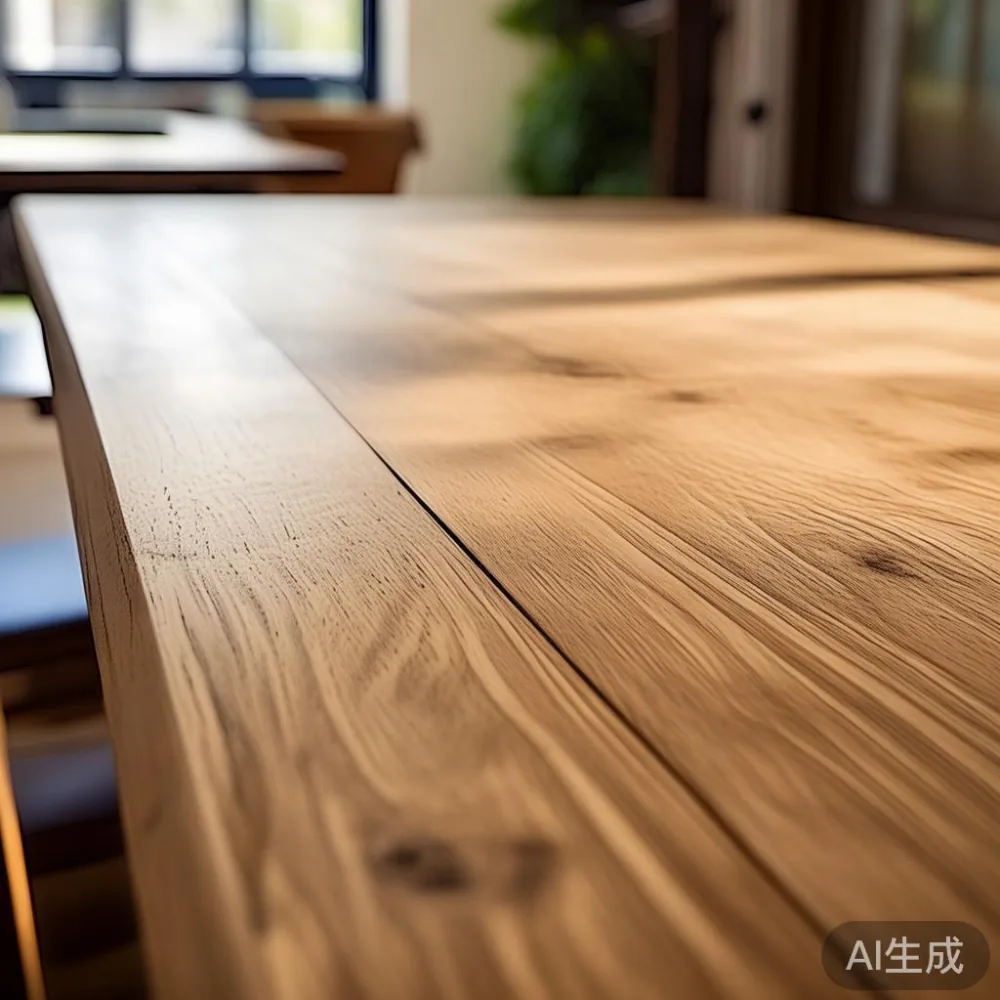
“Solid” should describe the visible structural parts, not merely the surface. Look for solid wood table legs, aprons, rails, and, where advertised, a solid wood top. Veneer is not automatically inferior; a well-engineered veneered top can be stable and visually consistent. The point is to know what you are buying. A low-priced dining table may have a solid wood frame and veneered top, while a higher-priced one may use solid boards throughout.
One practical warning: a photograph cannot confirm species. Ask for the commercial or botanical name, then request a close-up of the underside, edge, and end grain. At 180 × 90 cm, a top made from several joined boards can show normal lines. If the seller calls every surface “solid wood” without explaining panels and veneers, price comparisons become misleading.
What do board thickness and joinery cost?
More wood increases material cost, but construction matters more than thickness alone. A conventional 180 cm dining table may use a 20-25 mm top, 60-75 mm legs, and 70-110 mm aprons. Some designs use thinner profiles, slatted construction, or a trestle base. The important issue is whether the load path is engineered and the components are joined correctly.
Short joints and repeatable machining are efficient to produce. Complex curved joinery, angled legs, carved details, or many small components take more machine time and handling. Mortise-and-tenon, dowel, pocket screw, and proprietary metal-joint systems each have different cost and repair implications. A visible joinery method may improve a piece’s character, but dowels do not automatically make it stronger.
Last month I visited a Foshan workshop with a furniture colleague and measured several table frames. One lower-priced model had legs around 58 × 58 mm and slim rails; another used approximately 72 × 72 mm legs and deeper aprons. The heavier sample did not flex under my measured 120 kg point load, while a loosely assembled sample visibly moved at the joints. That comparison made geometry clearer than a marketing description.
Ask about movement allowances, fastener placement, and how the top is attached. Seasonal expansion should not split the top or twist the base. A competent maker should be able to explain the assembly with drawings or a sample rather than relying on the phrase “built like a tank.”
Why do some dining tables cost several thousand dollars?
The price ceiling often comes from design execution, not from a large increase in timber volume. Curved edges, softened corners, sculpted aprons, book-matched grain, hand finishing, and complex legs require more design, moulds, setup, inspection, and skilled labour. A rectangular table with square legs can cost less than half as much as a similarly sized organic form, even when the timber grade is comparable.
Finish is another substantial driver. A clear water-based coating may add roughly SGD 80-180 before GST on a standard 180 cm dining table. Multi-layer hand rubbing, tinted oil, matte lacquer, or a more demanding factory finish can add SGD 250-700. Premium finishes may improve touch and repairability, but the number of coats is less informative than the preparation, colour consistency, and cured surface quality.
French light luxury, American light luxury, and post-modern light luxury offer useful visual references, but the category label does not guarantee timber or construction. A French provincial dining table may use turned legs and softened profiles; an American light-luxury version may pair pale oak with clean lines; a post-modern light-luxury piece may combine curved forms with restrained colours. Search results for the best Modern light luxury furniture can be dominated by imagery rather than production data. Compare the same dimensions and specification.
Design fees also affect custom work. Standard models can be produced in batches, reducing setup costs. One-off dining tables may include design, prototyping, and tooling charges. If a piece costs SGD 4,200 before GST, determine how much represents materials, fabrication, finish, and one-off development.
The same price logic extends to neighbouring categories. A solid wood sofa may cost more because of frame engineering, suspension, upholstery, and labour. A solid wood bed frame is simpler than an upholstered bed but still varies with joints and finish. A MIDHILL European light luxury wardrobe reflects the material, hardware, interior fittings, and finish. A marble table carries weight and fabrication risk, while a nightstand is influenced by drawer hardware and joinery. The phrase is American bed worth it is best answered by comparing the frame, support system, and use rather than by origin alone.
How much should a 180 cm solid wood dining table cost in Singapore?
A useful working range for an adult-sized 180 × 90 × 75 cm dining table is about SGD 1,290 to SGD 3,800 before GST. More decorative designs, rare timber, extensive hand finishing, or complex bases can exceed SGD 5,000. The exact figure depends on specification, not just the product name.
At the lower end, around SGD 1,290-1,790 before GST, you may find a solid-wood frame, veneered or simpler solid-wood top, standard finish, and batch-produced construction. In the middle, roughly SGD 1,900-2,900, you can expect more deliberate proportions, better finishing, and clearer structural information. From about SGD 3,000 to SGD 4,500, the table may feature premium timber, more complex shaping, refined joinery, or a higher-grade finish.
These are comparison bands, not guarantees. A SGD 900 table and a SGD 5,000 table cannot be judged from photographs. Request the full specification, including top material, frame timber, dimensions, finish, weight, warranty, and delivery terms.
For HDB homes in Tampines, Bedok, and Punggol, the dining table must also be measured against the room and access route. A compact 120 × 70 cm table seats 4 and may suit a tighter dining zone, while a 160-180 cm table can seat 6. For condos, the relevant measurements are lift door width, lift car depth, corridor turns, and the narrowest internal doorway.
A common HDB lift car might provide roughly 110-140 cm of door width and 210-240 cm of depth, but blocks and service lifts vary. A 180 cm table top cannot turn through a 90-degree corridor corner unless the packaging and geometry allow it. Confirm measurements with the building office or delivery contractor before ordering.
What should I check before paying for delivery?
Delivery can add SGD 80-250 within Singapore for a normal floor delivery, with extra charges for carrying, stairs, or remote locations. If the table is fully assembled and still cannot fit the lift, the seller may need to remove the top or legs. That is not always included in the listed delivery fee.
Ask whether delivery is curbside, room-of-choice, or assembly included. Confirm the estimated delivery window in working days, the vehicle type, and whether narrow-access surcharges apply. Some sellers quote 5-10 working days; custom finishes may take 20-40 days. Do not confuse production time with dispatch time.
Singapore buyers should compare the landed offer carefully. An imported table priced at USD 2,400 is not directly comparable with an SGD 3,200 local retail price after freight, customs, GST, and local delivery. MIDHILL, established in 2008 and exporting to more than 15 countries, states a 10-year structural warranty and lifetime refinishing, but every seller’s warranty scope should still be read in full: whether it covers joinery, cracks, finish, and labour or only replacement components.
For higher orders over US$350, MIDHILL offers free shipping under its stated policy, although the exact Singapore quotation and duties should be confirmed. A 14-day return window also provides useful protection, yet return freight, restocking charges, and custom-order exclusions can matter. Keep photographs, packaging, and access instructions until the table has been checked.
Does a heavier dining table mean better quality?
Not necessarily. Weight comes from timber density, dimensions, and construction. An 180 cm table might weigh 45-75 kg, while a thick, sculptural design can exceed 90 kg. More weight can feel substantial and may slow movement, but it does not prove that the joints are tight or the finish is durable.
Heavy tables are harder to move and riskier for stairs and elevators. A 70 kg dining table may need 3-4 people, lift capacity, and an insured delivery crew. Confirm whether the top separates from the base. For compact Singapore dining rooms, a 42-55 kg table with removable legs may be easier to manage than a monolithic 85 kg design.
Look for signs of controlled movement: solid-wood components, suitable joint spacing, stable bases, and access to fasteners for future tightening. Check whether the top is crowned intentionally or uneven because of poor moisture control. Small gaps may be acceptable in panel construction, but large warping requires investigation.
How do style and brand affect the price?
Style affects labour and component choices. A shaker-style dining table with square legs can be economical to manufacture. French provincial details introduce curves and profiles; mid-century forms may use angled legs and shaped edges; contemporary designs can conceal complex engineering. Even when timber is similar, a design produced in low volume costs more per unit.
Brand pricing may include product development, quality control, after-sales support, packaging, and distribution. It may also include showroom costs and marketing. The aim is not to dismiss branding; it is to identify the visible output. A 10-year structural warranty is meaningful if the terms are clear. Lifetime refinishing is useful if the customer can use it and the process is documented. Free shipping above US$350 and 14-day returns reduce purchase risk. These service elements deserve comparison alongside timber and joinery.
Style research can still help. If you are comparing the best French provincial sofa for 2026, look for frame construction, seat suspension, and fabric rather than relying on the name. The same discipline applies to the best Vintage sofa for 2026 and the best Mid-century modern sofa for 2026. For wood dining furniture, the better Vintage sofa for 2026 is not relevant, so the real proof remains the physical sample. Likewise, the MIDHILL TV console should be evaluated by its material, stability, cable management, and finish rather than its trend status.
What questions should I ask before ordering a dining table?
Ask for the top material and species, the dimensions with a 1-2 cm tolerance, the approximate weight, the frame construction, finish type, maintenance instructions, warranty coverage, return terms, and the complete delivery route. Request photographs of the actual model, including the underside and joint areas. For a dining table, the quality of the top, base, and connection should be inspected as one system.
For an HDB flat, measure the route rather than estimating: lift door, lift depth, hallway width, landing turns, stair width, and dining-room doorway. Allow several centimetres of working clearance. A 180 cm top often arrives as two 90 cm sections, which can work through a tight corridor more easily than a single slab.
At the store or showroom, sit at the table, move a chair, and place a heavy dish near the centre. A stable table should not rock. Open any drawers or extensions and check their travel. If the dining table is sold with chairs, assess the combined footprint and the distance needed to pull a chair back. Six chairs may require at least 300-360 cm of circulation space in a practical layout.
Ultimately, the price of solid wood furniture reflects a stack of decisions: species, thickness, cutting, joinery, shaping, finish, hardware, design, inspection, packaging, and service. The highest number on the label is not automatically the wisest choice. Compare like-for-like specifications, confirm that the piece fits both the room and the access route, and treat structural assurance, refinishing support, and realistic delivery as part of the value—not as footnotes.