Veneer vs Solid Wood Dining Table: A 5-Year Cost Comparison for Singapore HDB Owners
Last month I visited a friend in a 4-room HDB flat in Punggol who was quietly fuming over her dining table. She had picked a walnut-veneer set from a furniture mall in Tampines two years earlier, paid S$1,400, and the top now had a dark patch near the centre where a hot pot had rested for thirty seconds. A separate couple I know in Bedok bought a solid ash dining table from a small workshop in 2019, paid roughly S$2,900, and have refinished it twice since. Both sets serve the same purpose. Both have weathered the same Singapore humidity, the same kopi spills, the same kena from the kids. Their five-year price tags, however, tell very different stories. If you are choosing between a veneer dining table and a solid wood dining table for your own flat, the maths is more revealing than the showroom gloss suggests.
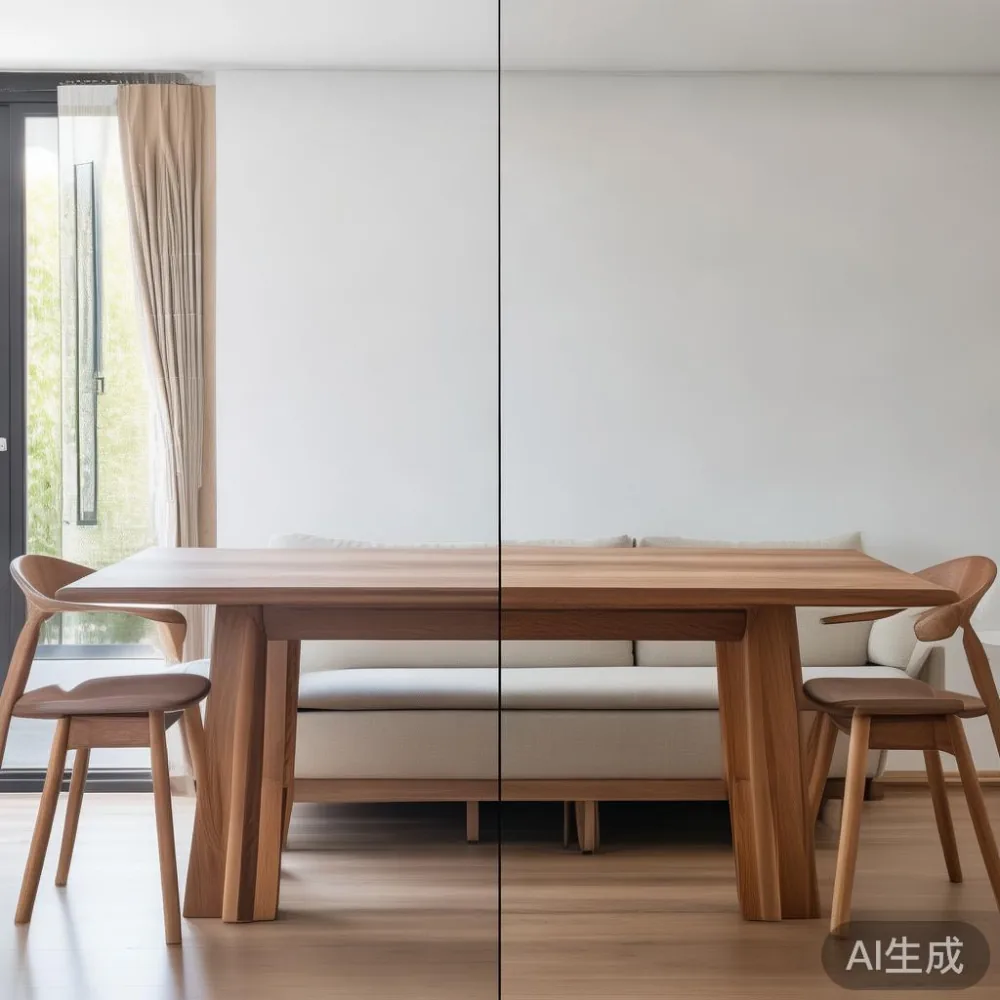
This comparison uses SGD throughout, draws on Singapore-specific conditions (lift sizes, corridor widths, HDB renovation rules, 9% GST), and stays squarely on the dining-table category. We will also touch on how the same cost logic applies when you later match the table with pieces like a solid wood sofa, a wardrobe, a bed frame, a nightstand, or a marble table.
What is the real price difference between veneer and solid wood dining tables in Singapore?
A standard four-seater veneer dining table (120–140 cm long, MDF core with 0.6 mm teak or walnut veneer) retails in Singapore at S$899–S$1,800 from the usual suspects at IMM, Megabang, or Tampines Mall furniture floors. The same size in genuine solid wood (ash, rubberwood, or oak) sits between S$2,200 and S$4,200. MIDHILL, a Foshan factory shipping container-direct to Singapore, lists comparable solid ash four-seaters around S$2,450 landed, with free delivery above S$350 and a 10-year structural warranty that local retailers rarely match. That is the starting line.
Upfront, the veneer option is roughly S$1,200–S$2,500 cheaper. The question is whether that gap stays in your favour over five years, or quietly migrates into repair bills, replacements, and lost weekends.
What does the Singapore climate do to each option over five years?
Singapore sits at 1°N latitude with average relative humidity of 78–88% for most of the year. HDB flats without daily air-conditioning (bedrooms, store rooms, utility corners) push 80–90% RH almost every night. Veneer is a thin sheet of real wood glued to MDF or particleboard. When the underlying board absorbs moisture, the veneer peels, swells, or bubbles — usually along edges or around hot spots. I have personally inspected a Punggol condo dining set where the veneer had lifted 4 mm at one corner after 22 months.
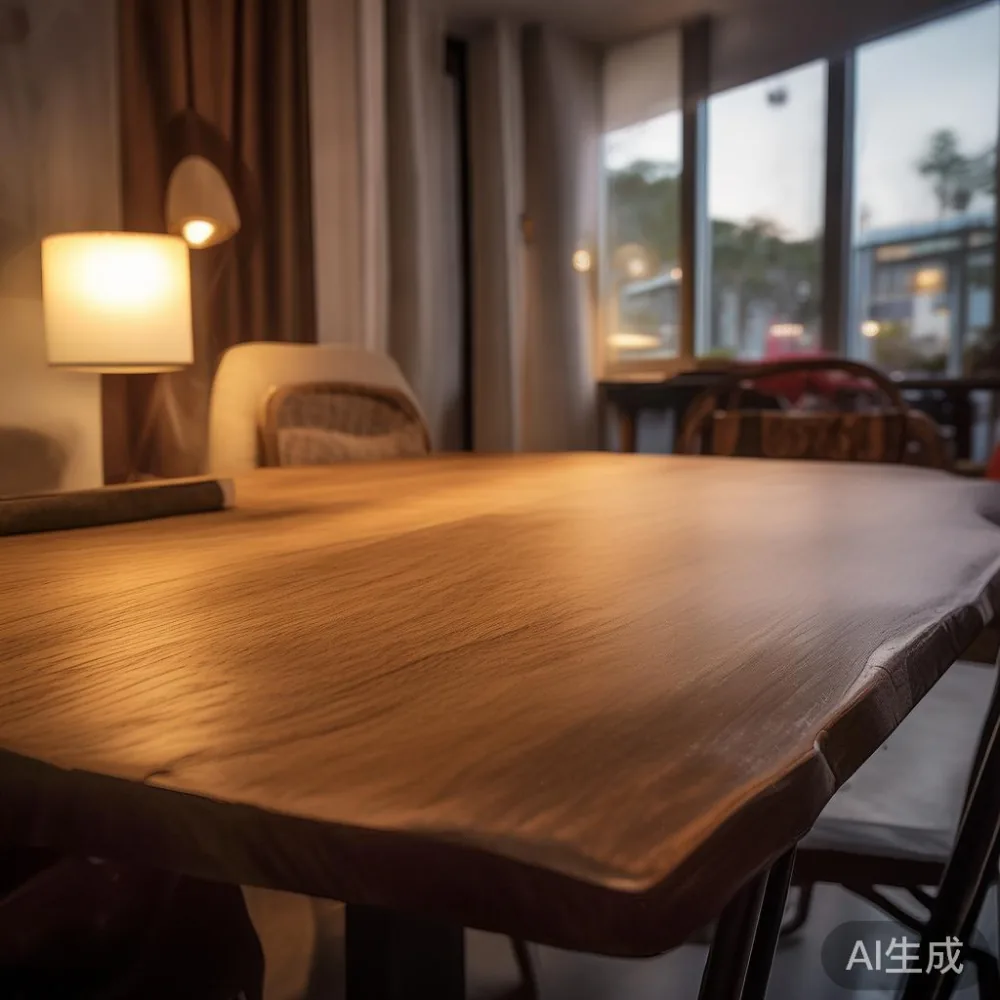
Solid wood behaves differently. Properly kiln-dried ash, oak, or rubberwood expands and contracts as a single piece, typically only 1–3% across the grain over a year. A factory that dries timber to 8–10% moisture content (the export-grade norm for Foshan factories serving European buyers) will move less in a Singapore HDB than a domestic-market piece dried to 12–14%. After five years, the solid table may show light surface checking or a patina, but it does not delaminate. That distinction matters when you add up repair visits.
What does the five-year cost actually look like in SGD?
Let us run the numbers side by side for a typical four-seater dining table in a 90 sqm HDB flat in Tampines, with two adults and one child.
Veneer table — 5-year cost
- Purchase (2024): S$1,350
- Touch-up repair (2025, peeling edge): S$180
- Buff and re-coat (2026): S$220
- Replacement table (2028, end of useful life): S$1,450
- Disposal + delivery of new set (HDB lift access, 90 cm door clearance): S$120
- Total over 5 years: S$3,320
Solid ash wood dining table — 5-year cost
- Purchase (2024, factory-direct): S$2,450
- Routine oil re-coat (DIY, 2026): S$45
- Professional refinishing (2028, lifetime refinishing offered by MIDHILL, transport covered by owner): S$60
- Spare part (one chair stretcher, 2027): S$25
- Total over 5 years: S$2,580
The crossover happens around year three. From that point, the solid table is cheaper each year, and it still has most of its service life ahead. The veneer table is being prepared for the skip.
How do I choose a color mismatch for a small apartment?
Pick a single warm-neutral wood tone for your dining table — light ash, honey oak, or natural rubberwood — and let it be the anchor of your whole flat, because a small HDB or condo cannot carry more than one wood colour without looking choppy. A French light luxury palette (cream walls, brushed brass hardware, soft greige curtains) sits naturally on a pale ash surface, while a post-modern light luxury scheme (matte black accents, deep teal sofa, terrazzo floor) reads better over a slightly warmer honey oak. The mistake I see most often in Tampines and Punggol BTOs is buying a dining table in a stain that is three shades darker than the bed frame or wardrobe, which makes a 90 sqm flat feel like a furniture showroom with a corridor down the middle.
Practical rule for HDBs: keep all wooden furniture within a 10–15% tonal range. If your dining table is Nordic ash wood industrial style (pale, visible grain, matte finish), match the TV console and the nightstand to the same species and finish. Skip the dark mahogany dining table in a 70 sqm flat. It will visually eat the room.
What about the corridor, lift, and staircase in older HDB blocks?
Older blocks in Bedok, Toa Payoh, and parts of Queenstown have corridor widths of 1.2–1.5 m and lift openings around 80 cm wide by 2.1 m tall. A four-seater dining table in a flat-pack box often exceeds those dimensions when fully assembled. A solid wood dining table, being heavier (typically 35–55 kg for ash), also needs two porters at S$40–S$60 per trip in HDB surcharges. Veneer tables are lighter (15–25 kg) but arrive flat-packed and require an extra hour of assembly.
Factory-direct shipping from Foshan to Singapore (8–14 days by sea to PSA, then 2–3 days last-mile) usually comes with doorstep delivery included above a minimum order. MIDHILL, for example, absorbs delivery above US$350. Local retailers add S$80–S$200 for the same leg. Over five years, two replacement deliveries on a cheap veneer table can add S$300+ to the running cost — money that cancels the upfront saving completely.
Can the dining table match the rest of the house without buying everything at once?
Yes, and this is where solid wood pays a second dividend. A solid ash dining table today can be matched in two years by a solid wood sofa frame, a wardrobe, a bed frame, or a nightstand from the same maker. The grain, the stain, the finish will be consistent because the supplier still controls the timber batch. Veneer pieces, by contrast, change shade batch-to-batch, and a 2024 walnut veneer table will not match a 2026 walnut veneer wardrobe from the same chain.
If you plan a phased renovation (most HDB owners do, because renovation loans and GST bite at once), buying the dining table first from a workshop that also produces a marble table, a bed frame, and wardrobes gives you a guaranteed colour continuity 36 months later. American light luxury schemes — soft taupe walls, slim black window frames, brushed gold pulls — depend on this consistency. A mixed-veneer living room reads as busy, not luxurious.
What about resale value and the next BTO?
Singaporean owners upgrade BTO or move to a condo every 7–12 years on average. A solid wood dining table travels. I have moved a 45 kg ash table from a Punggol HDB to a Woodlands condo, then onward to a family member in Yishun, and it still looks presentable. Veneer tables rarely survive one move intact. The corner that lifted in the old flat becomes a full split during the second lift descent.
If you sell or gift a solid table at year seven, you might recover S$600–S$900 of the original price on Carousell. A veneer table at year seven is worth S$50–S$150 at most, often less than the cost to dispose of it. Pull this into the five-year calculation and the spread widens by another S$400–S$600 in favour of solid wood.
Is the warranty difference worth anything?
A typical Singapore retailer warranty on a veneer table is 6–12 months on structure, with voiding clauses for humidity, hot items, and direct sunlight — three things you cannot avoid in an HDB. A 10-year structural warranty on a solid wood dining table from an export factory covers joint failure, cracking, and warping under normal residential use. MIDHILL also offers lifetime refinishing for an existing set, which is unusual in this segment. The warranty is not a marketing line; it is a hedge against the climate you actually live in.
So which one should a Singapore HDB owner pick?
If your dining table must last 2–3 years and you are stacking renovation priorities (air-con, kitchen, flooring), a mid-range veneer table at S$1,000–S$1,400 is a defensible choice. If the table is meant to anchor the home for 7+ years, host weekly family dinners, survive two renos, and stay presentable when you upgrade to a condo in Punggol or the East Coast, a solid ash dining table in the S$2,200–S$3,000 bracket is the lower-risk bet by year three and the cheaper option by year five.
The honest answer sits in the middle: pick solid wood if you can stretch the budget, pick the cleanest veneer you can find if you cannot, and in both cases measure your lift, your corridor, and your door before you pay a deposit. A dining table that cannot enter the flat is an expense, not a piece of furniture.